Estate wedding photos are images captured at private properties where the venue itself shapes the final frame.
The building or grounds do half the work, which means couples who fight the estate’s character end up with photographs that look expensive and hollow.
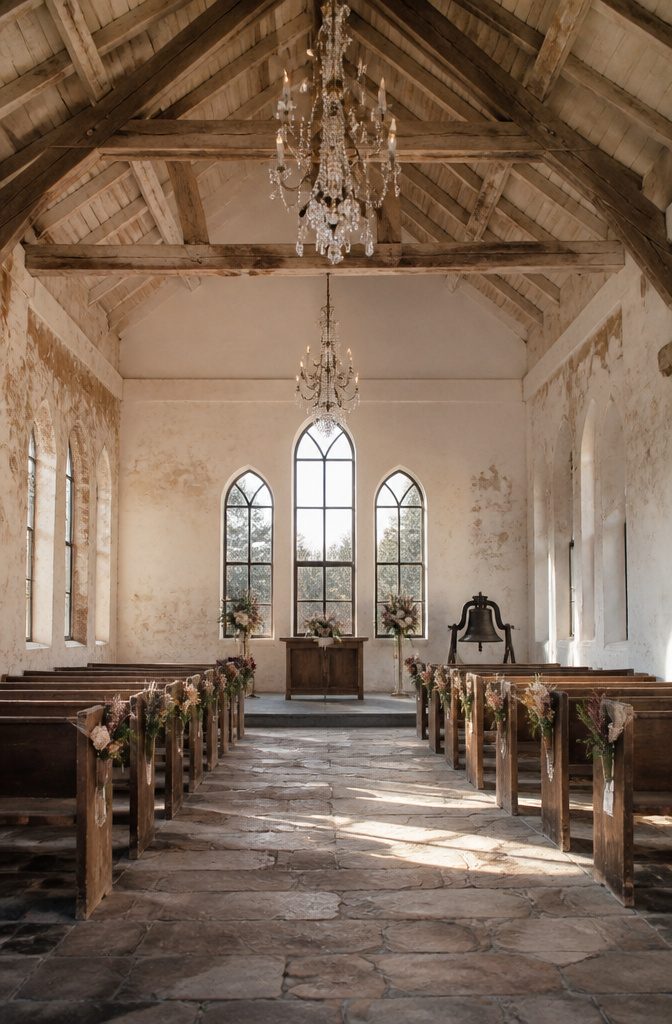
At the Morris Estate’s Chapel, photographers seek out the original steeple bell rather than editing around it; the couple who lets the chapel lead gets images no uplighting can manufacture.
1. Historic Estates
Age gives a building permission to be imperfect, and that imperfection is exactly what the camera wants.
A historic estate does not hand you a blank slate; it hands you a steeple bell that has rung for nearly a century, plaster that has settled into gentle curves, and windows that throw light at angles no modern architect would allow.
The couple who lets the venue lead, rather than fighting to cover it up, gets photographs no draping or uplighting can manufacture.
The Morris Estate’s Chapel stands as one example of this principle in practice.
Its crisp white interior reads as a deliberate palette, not a void to be filled, and the original steeple bell remains a detail photographers seek out rather than edit around.
Because the space is climate controlled, the light stays consistent enough to plan for, which matters when your ceremony runs twenty minutes past the timeline and golden hour is not negotiable.
What separates historic estates from newer venues is the density of these unrepeatable elements per square foot.
A modern build might offer one photogenic corner; a century-old chapel offers six before you have placed a single flower. What you give up is control.
You do not select a historic estate to project a theme onto it. You select it because the theme is already there, weathered in, and the photographs prove you were present for it.
2. Garden Estates
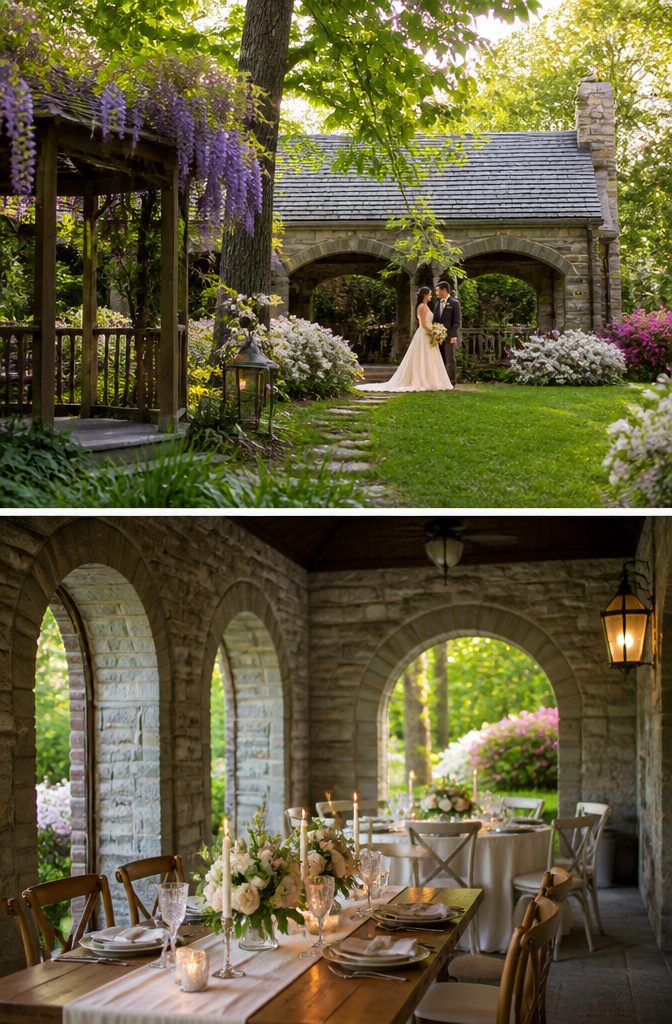
Garden estates live or die by their growing season, and photographers feel that pressure more than anyone.
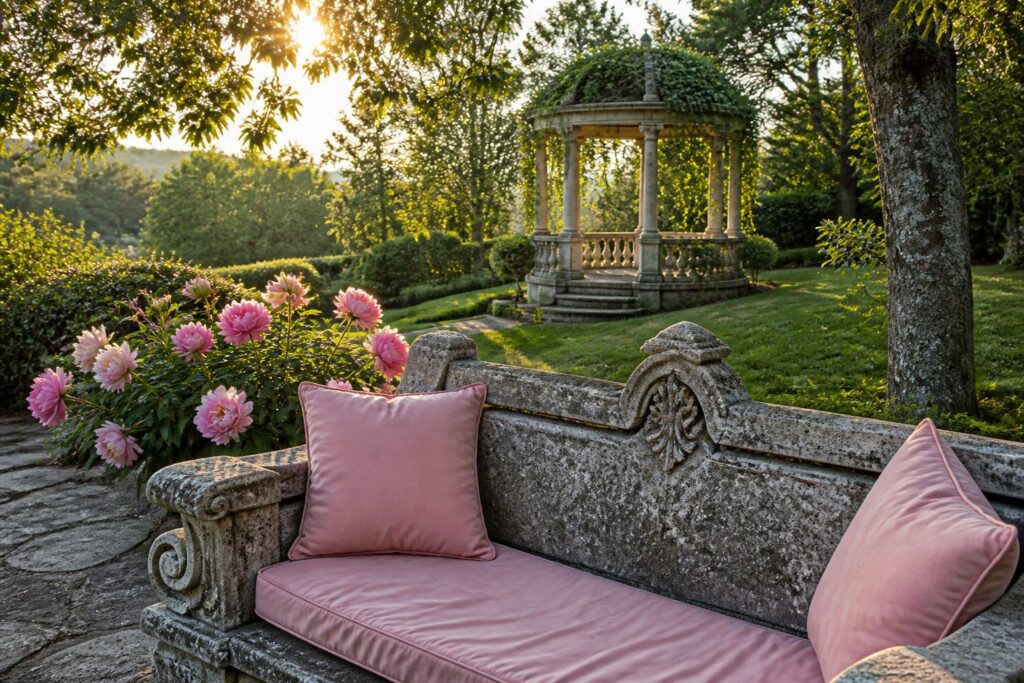
The Grove Redfield Estate sits on 150 acres in Glenview with a stone pavilion, wooden gazebo, and water features set against what the grounds crew has managed to coax from the soil that year.
Spring weddings there get the fresh green wall of new growth; fall couples trade that for the harder color of turning leaves.
Both peaks have their own problem. Spring greenery can read as flat in overcast light if your photographer doesn’t find texture in the individual plants.
Fall color peaks fast and drops faster, so a venue booked for "late October color" might deliver bare branches if the wind turns.
The practical strength of a garden estate is layered backdrops without leaving the property. One turn past the pavilion fireplace and you are in tree shade; another puts the water feature behind you.
That variety saves time on a tight wedding-day schedule. What you accept is dependence on the grounds crew.
A historic building holds its looks; a garden holds them only until the next drought, freeze, or overgrowth cycle. Ask the venue not just what blooms when, but what their backup plan is for the beds that fail.
3. Rustic Estates
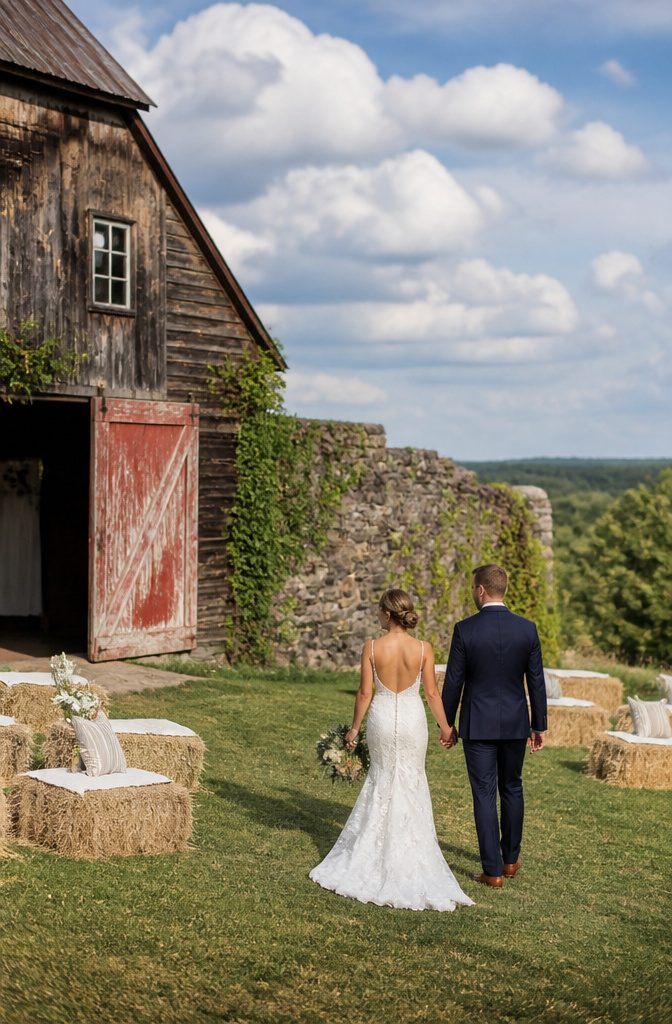
Weathered wood, rusted iron, and limestone worn soft by decades of rain give rustic estates their particular hold on the camera.
These surfaces absorb light instead of throwing it back, which flatters skin tones in a way polished marble never quite manages.
The patina is the point: a barn door with peeling red paint or a fieldstone wall missing half its mortar reads as time earned, not installed last spring.
That distinction matters because rustic has become a style to buy.
Couples now tour venues where distressed beams were ordered from a catalog and "reclaimed" oak was run through a factory belt sander. A photographer’s job becomes telling the difference in a single frame.
True wear catches light unevenly; staged wear repeats the same scratch pattern across six identical tables. The camera notices even when the eye does not.
Some couples seek this aesthetic precisely because it resists perfection.
A dress hem dragging through meadow grass, cake served on rough-hewn planks, the inevitable smudge of real dust on a velvet chair: these are not failures at a rustic estate but the reason for choosing it.
The venue cooperates with honesty rather than demanding polish.
4. Luxury Estates
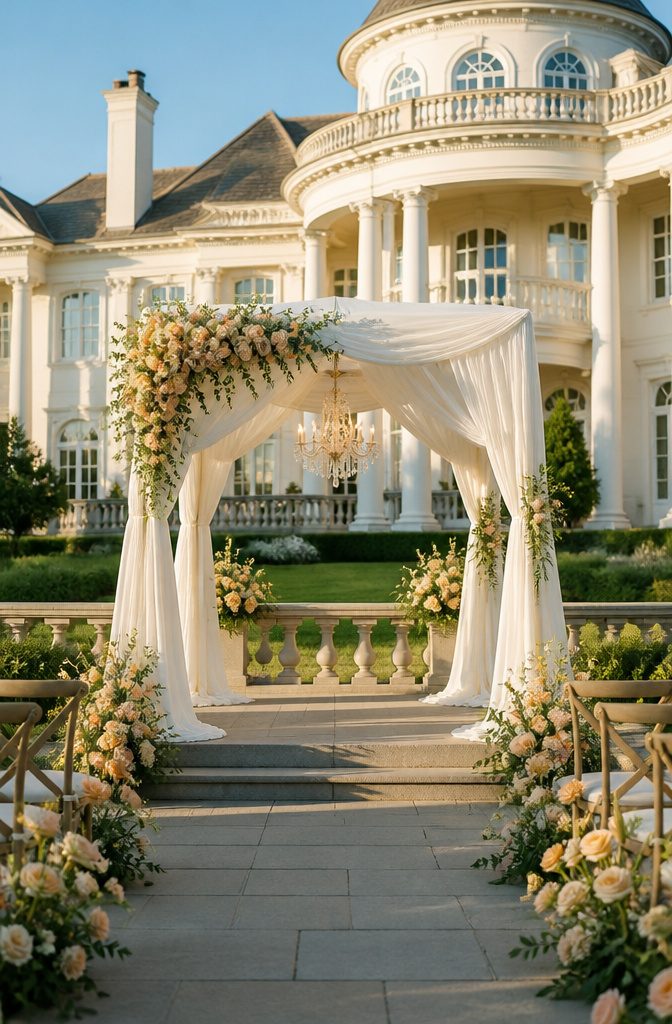
A Georgian mansion like The Great Marsh Estate carries scale and formality in every proportion. The covered ceremony site and reception rooms were built for grandeur, and the grounds spread wide enough to lose a bridal party in.
For a couple whose budget sits under $10K, the risk is paying for a space that photographs their twenty guests like scattered furniture in a hotel lobby.
The architecture does half the work. Columns and symmetry read as classic and timeless on camera without added decoration.
What the photographer has to supply is compression: a long lens from the balcony rail, a first touch framed in a window bay rather than the full façade.
The venue’s covered ceremony site works for intimate weddings precisely because the roof and posts create a room where none existed, cutting the sky down to a manageable backdrop.
Indoor getting-ready rooms with window light give the day its quiet opening shots. The couple can stage their preparation in a space that already looks considered, rather than renting a separate suite.
The real savings come from using what the estate already owns: the grounds for portraits, the built-in bar and patio for cocktail hour, the oak canopy or garden structure for ceremony framing. Each of these removes a rental line item.
The judgment call is how much of the house to show. A full establishing shot of a Georgian mansion dwarfs a small guest count.
Better to let the architecture peek in at the edges: a column behind the vows, the lawn stretching just past the last row of chairs. The camera should suggest the estate, not inventory it.
5. Waterfront Estates
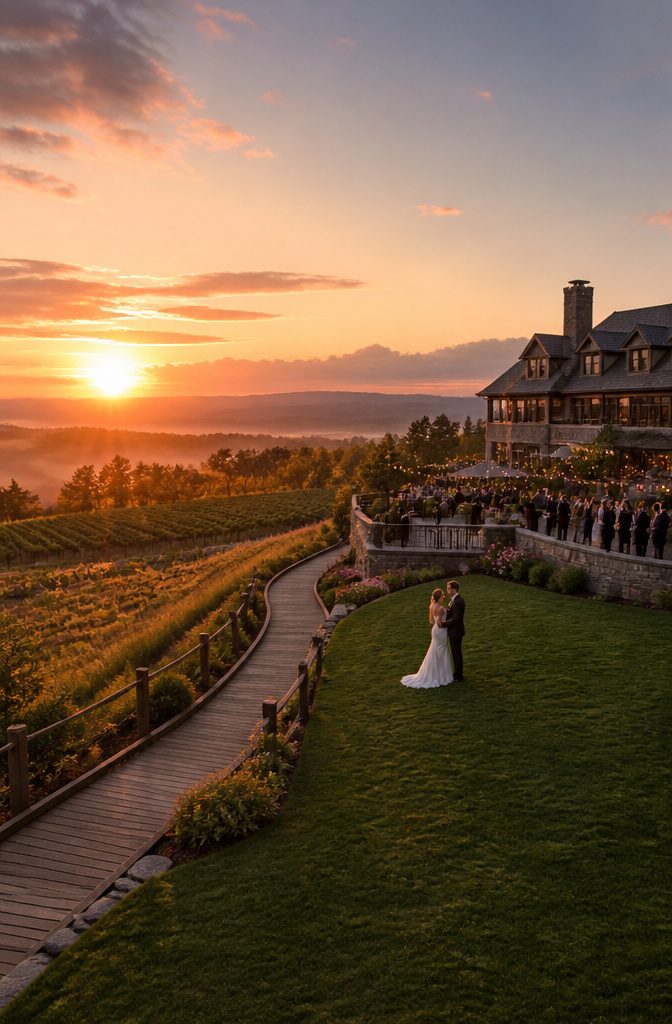
Waterfront estates occupy the smallest slice of the estate category, which makes them easy to overlook until you see what a living backdrop actually does for a camera.
The Inn on Biltmore Estate sits atop a hill overlooking the Biltmore Vineyards, and that view is not a static thing.
Morning haze softens the rows into watercolor; golden hour sets the vines on fire; blue dusk pulls the mountains forward in layers. The backdrop changes, so your timeline must change with it.
A vineyard or water view forces harder timing decisions than a garden or chapel wall.
The photographer and coordinator have to move portrait sessions to catch the light at specific angles, and that movement only works if the estate team planned the day around it.
The Inn on Biltmore Estate operates within the larger Biltmore House and Gardens, so the logistics are not simple: one path to the hill, one window for the shot, and the rest of the schedule bending around both.
Smaller guest counts help here. The property’s scale suits an intimate wedding better than a packed tent, because the couple has room to step away for twenty minutes when the light turns right.
For budget-conscious pairs, the trade is steep: you are partly paying for a view that disappears if you schedule against it.
6. What Estate Venues Share
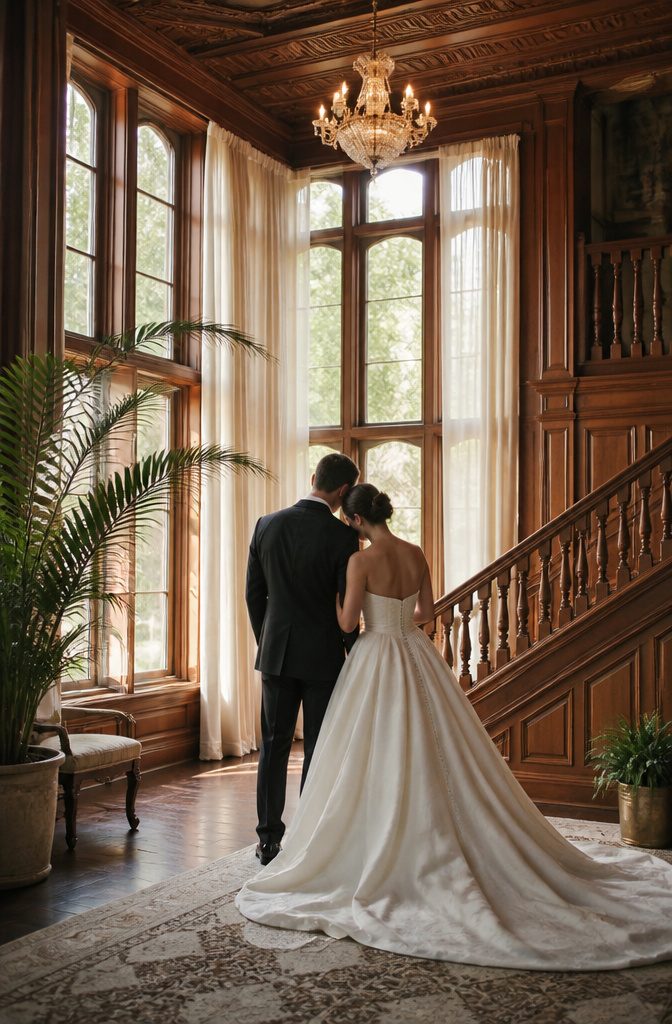
An estate venue gives a photographer three built-in assets that do not depend on whether the house is Georgian, Craftsman, or something built last decade.
The structure itself provides architectural presence: columns, staircases, tall windows, and proportions that frame a couple without needing much styling.
The light behaves differently inside a room with fourteen-foot ceilings than it does in a standard ballroom, and that difference shows up in the final images even when the couple cannot name why one feels grander.
The grounds function as a second location without the logistics of leaving the site. At Cameron Estate Inn, the same couple moves from interior formality to natural settings in minutes, which stretches the visual story of the day.
Time that would go to shuttling between a church and a park stays in the timeline for portraits.
Privacy matters more than couples expect until they have attended a hotel wedding where tourists wander through cocktail hour. An estate’s removal from strip malls and traffic lets guests relax, and that ease translates to candid photographs.
The Morris Estate’s Chapel and Tent setup works partly because the property is maintained as a single, controlled environment; photographers are not fighting background clutter or asking strangers to step aside.
These constants mean estate wedding photos share a baseline quality even when the specific style varies widely.
7. How Estates Change the Photography
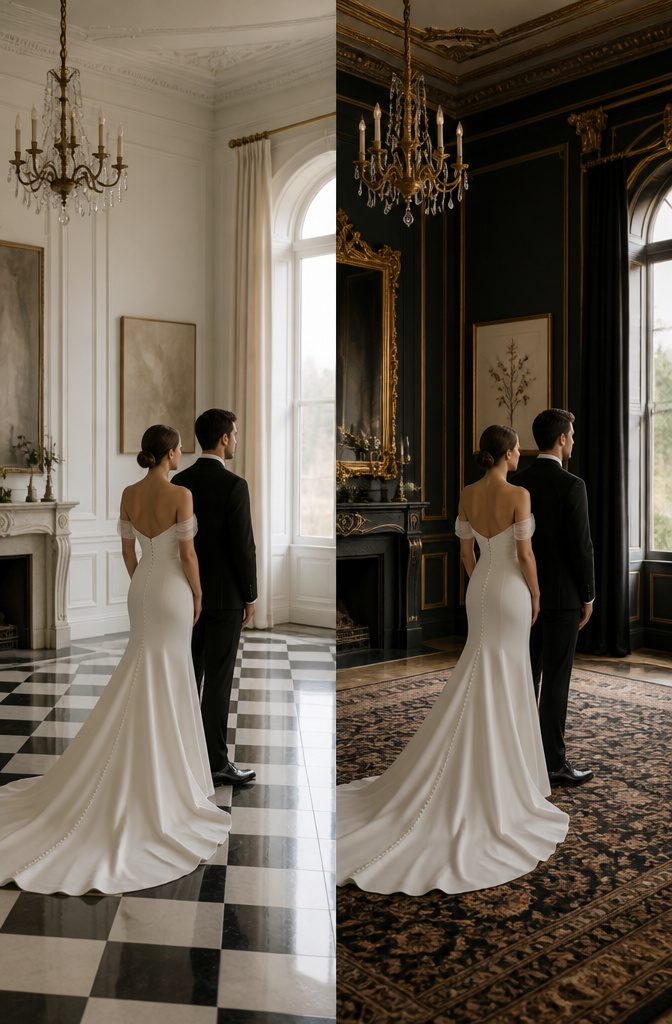
An estate venue gives a photographer three distinct ways to work, and the building itself usually decides which one wins.
Editorial photography favors estates with formal architecture and controlled interiors. The black, white, and gold palette at Cameron Estate let the venue stay central while the couple’s styling read as intentional rather than competing.
Rooms with peach walls and blush florals, like those at Cairnwood, give the same advantage: color harmony that looks arranged even when nothing was staged.
These spaces need time, though. A bride changing into a second look and an updo between ceremony and portraits only works if the venue has private rooms near the shooting locations.
Documentary work needs guest movement and light in quantity. The Tent venue at Morris Estate draws photographers for reception work because open sides throw daylight across dancing and toasts without a flash changing the mood.
The Inn at Biltmore’s lawn and outdoor stairs serve the same purpose for processional shots: a long approach lets the photographer stay back and catch actual steps, actual faces, rather than pausing the walk for a pose.
Candid photography happens most honestly where guests forget they are being watched. A field behind Cairnwood, with the full estate in the background, pulls couples away from the crowd long enough to drop their shoulders.
The chapel exterior at Morris does the same for processional photography: the path creates distance from the main event, so emotion reads without performance.
What you trade is practicality. Editorial estates often limit how many guests move freely.
Documentary-friendly tents or lawns may lack the walls that make editorial portraits feel finished. Most weddings I plan use both: formal portraits where the building cooperates, then looser work where the grounds open up.
8. Personal Touches That Read on Camera
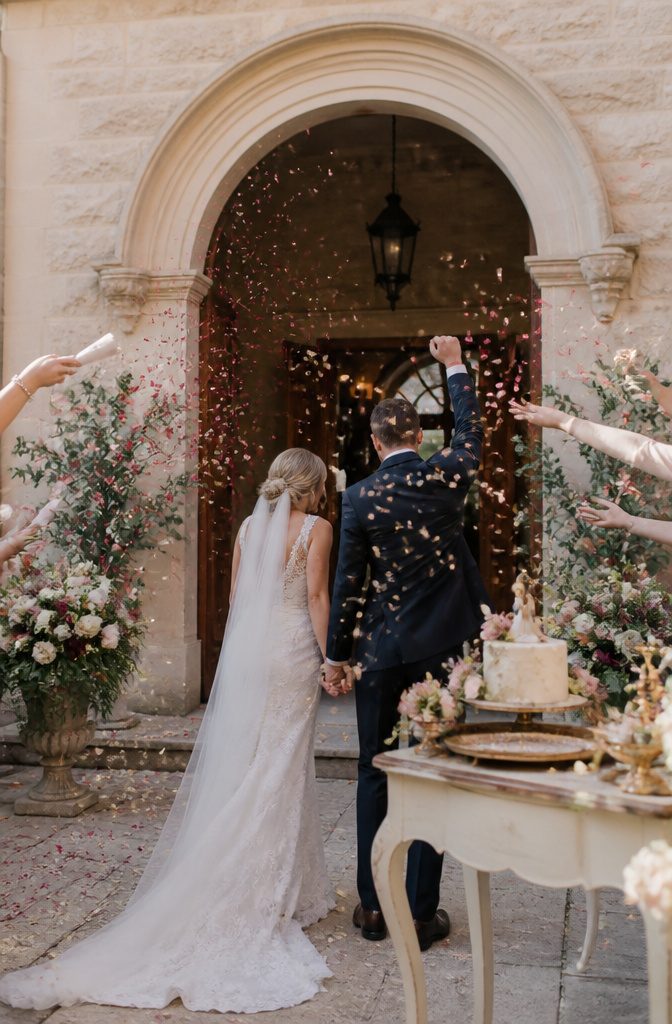
A dried petal toss down a stone aisle reads differently than one in a ballroom. The estate gives it scale, and gravity.
At one wedding, the bride had saved every flower the groom had ever given her; guests threw those dried petals as she walked, and the photographer caught them against limestone walls that turned the color warm instead of letting it blow out in daylight.
The backdrop has to work with the detail, not swallow it.
Family heirlooms need the same negotiation. A grandmother’s ceramic tub, styled with rings for a flat lay, sat on estate grounds where the weathered texture answered the glaze rather than competing.
The cake topper from another grandmother’s wedding, placed with their own cake, needed the right table placement so the estate windows gave it side light instead of flattening it into shadow.
Custom work risks disappearing in ornate settings. A hand-painted "Just Married" banner worked because the couple hung it where the estate’s own lines were simplest, not against carved stone.
The bar sign featuring their cats, the ice cream truck surprise, the T-shirt toss with its pizza pun: each one needed a photographer who knew the estate’s rhythms well enough to stage the shot before the moment passed.
The tattoo for Anna, the mother’s wedding dress remade for dancing, the photo pinned inside it: these details turn estate wedding photos from venue portraits into family documents.
9. The Guest Experience as a Photo Story
Estate weddings move differently than ballroom affairs, and that movement is what photographers chase.
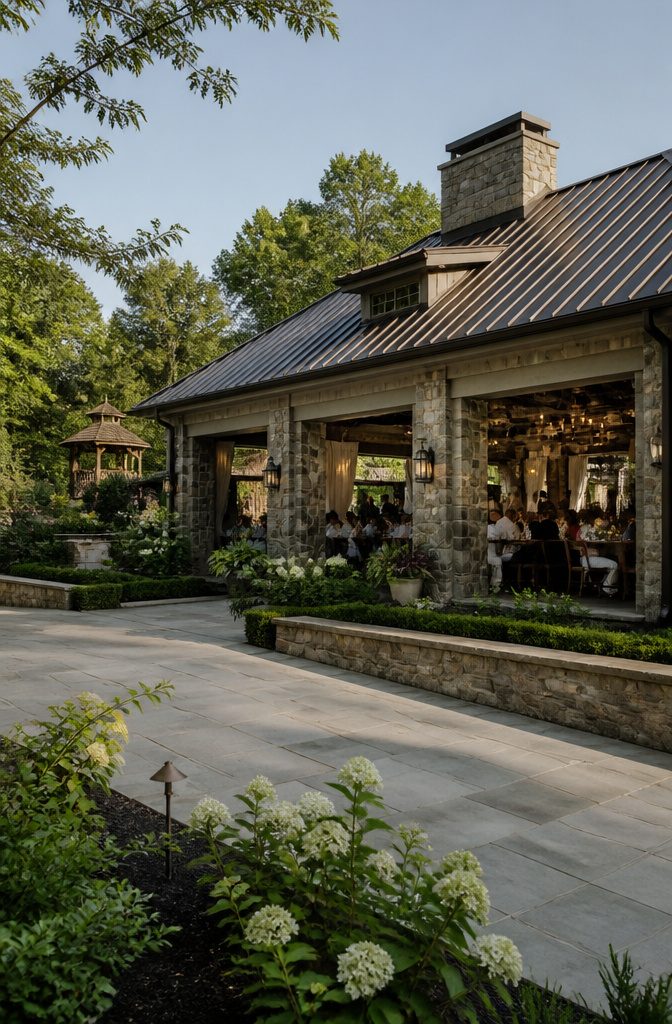
At The Grove Redfield Estate, the 30′ x 60′ stone pavilion with its outdoor fireplace and garden views draws guests into a natural arc: ceremony facing the fireplace, then a drift toward cocktails on the patio, dinner where the light has softened.
The photographer works with that flow instead of against it.
The pavilion’s scale matters. Thirty by sixty feet is large enough for 125 guests to gather without crowding, small enough that the camera catches faces, not anonymous rows.
The stone walls and seasonal urns give the wide shots structure; guests framed between masonry and greenery read as belonging there rather than posed against a backdrop.
What separates estate photos from hotel ballrooms is this sense of progression through a single property.
Guests move from the pavilion to the woodland gazebo to the lawn, and the photographer follows with continuity: the same couple in the same light, the same wedding party appearing in different corners of the same estate.
The story builds without anyone needing to stage it.
The best estate photographers treat the venue as a character, not scenery.
They know where the pavilion’s fireplace catches late sun, when the garden paths empty between courses, how long the walk from ceremony to cocktail hour takes and what guests do along the way.
That timing is what turns a sequence of pretty locations into a wedding story someone will want to rewatch.
Choosing Between Estate Types
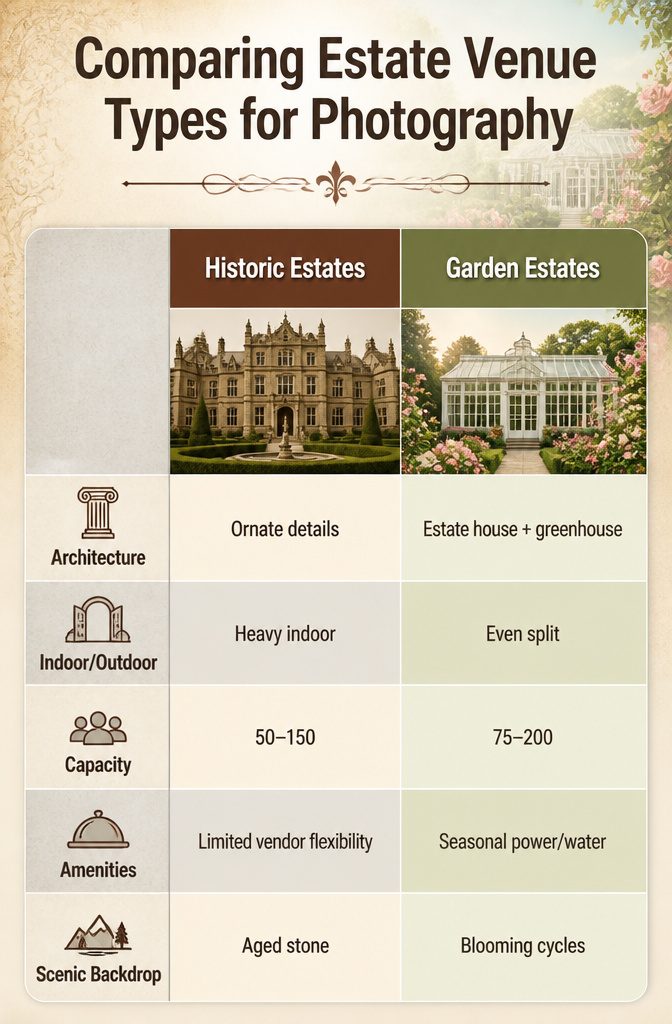
Estate venues fall into patterns once you start touring them, and the pattern that matters is what the camera actually gets to work with.
Some couples walk in and see the staircase; I end up studying where the afternoon light hits it and whether the getting-ready rooms have windows worth using.
The five attributes that separate one estate type from another for photography are architectural style, indoor-outdoor balance, guest capacity, built-in amenities, and the scenery surrounding the property.
Capacity limits often decide the style before you do: a historic manor that caps at 75 guests forces a different photography rhythm than a working farm that holds 300.
| Attribute | Historic Estates | Garden Estates | Rustic Estates | Luxury Estates | Waterfront Estates |
|---|---|---|---|---|---|
| Architecture | Ornate details, formal rooms | Estate house + greenhouse/conservatory | Barns, lodges, converted outbuildings | Modern build or full restoration | Coastal or lake houses, docks |
| Indoor/Outdoor | Heavy indoor; gardens as transition | Even split; ceremony often outside | Leans outdoor; indoor is backup | Climate-controlled priority | Outdoor ceremony, indoor reception |
| Capacity | 50–150 | 75–200 | 100–300+ | 75–250 | 50–175 |
| Amenities | Limited; vendor flexibility | Seasonal power/water for tenting | Often full-service barn kitchen | In-house everything | Weather-dependent access |
| Scenic Backdrop | Aged stone, patina, symmetry | Blooming cycles, hedge rooms | Fields, timber, equipment as texture | Landscaped grounds, hardscaping | Horizon line, reflection, wind |
Match the estate to your guest list first. The rest of the photography decisions flow from that number.
Vendor Matchmaking for Estates
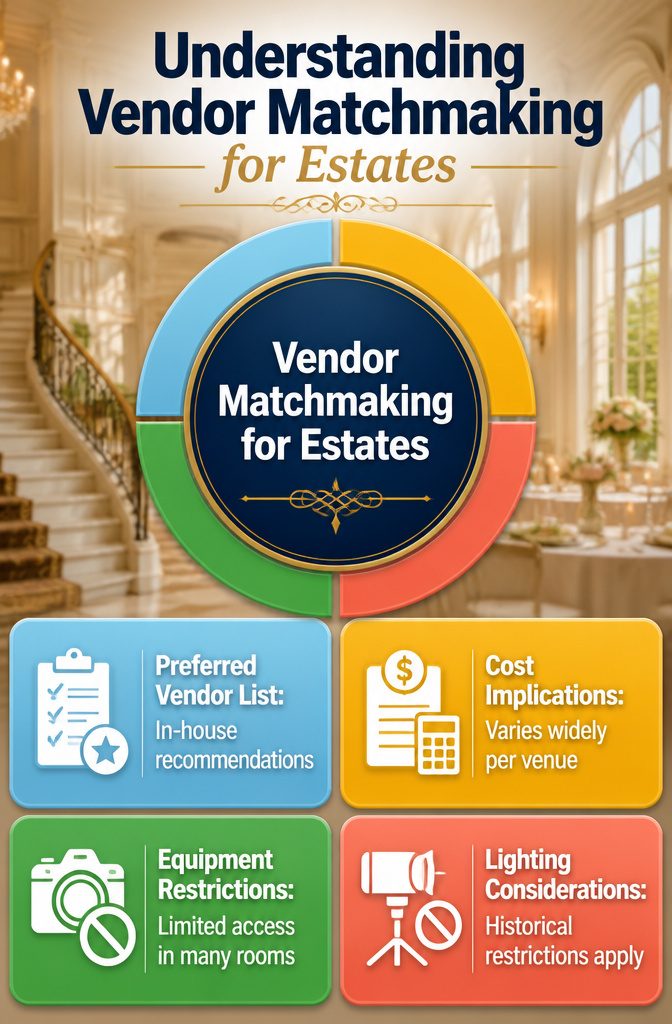
Estate venues almost always come with a preferred vendor list, and the photographer slot matters more there than at a hotel ballroom.
House rules are the reason: many estates limit where equipment can stand, which rooms are open for prep shots, and whether off-camera flash is allowed at all.
A photographer who has shot the property before already knows which staircase the staff will let you use and which they will not.
The light inside these buildings is another variable that separates experienced estate shooters from newcomers.
Grand rooms often rely on windows placed for 19th-century reading, not modern portrait work, and venues with historic status may ban supplemental lighting that would alter the fixtures.
The photographer who arrives knowing the actual window directions and the hour each room turns golden saves the schedule; the one who plans to "fix it in post" burns daylight and patience.
Marketing photos deserve skepticism too. Estates select their angles carefully, and a sweeping drone shot of the grounds does not reveal that the ceremony lawn sits in shadow by 3 PM in October.
A photographer with prior time on the property can tell you which marketed "iconic" backdrop requires waiting twenty minutes for tour groups to clear, and which quiet corner the estate never promotes but actually delivers.
Seasonal Timing
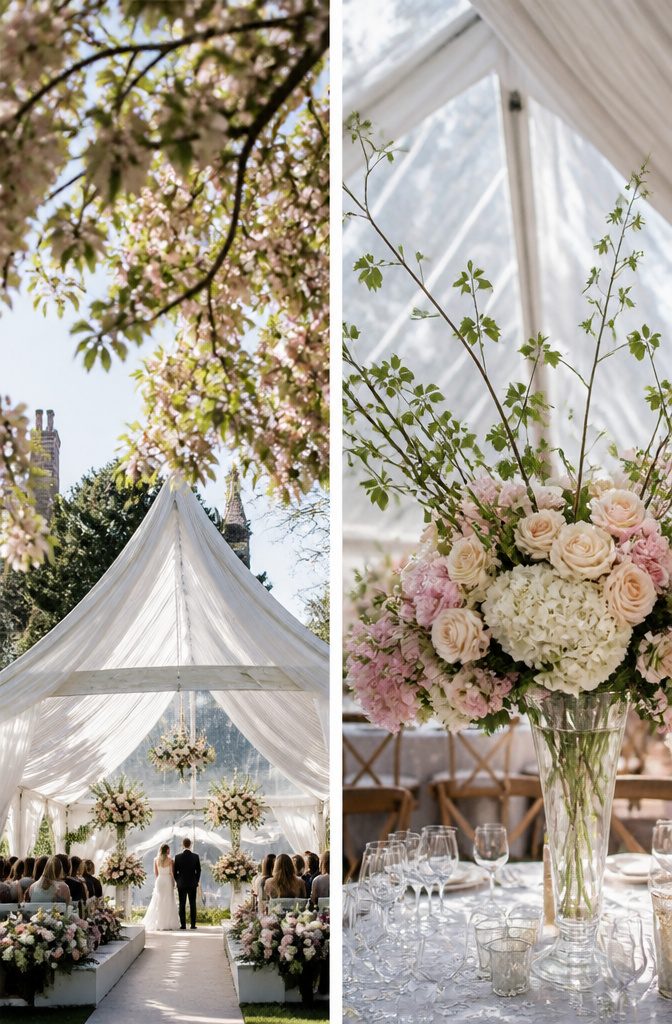
Spring garden estates and fall rustic estates each carry their own booking pressure that most couples don’t anticipate until they’re already six months out.
Garden estates peak in late April through May, when the Tent venue and similar spaces open their cathedral-sided structures to couples who want flowering backdrops without summer heat.
That demand means dates at sought-after properties get claimed up to 24 months ahead, and photographers who know those grounds well are booked nearly as early.
Fall rustic estates run on a parallel track, with September weekends especially competitive.
The September wedding I photographed at Willowdale Estate delivered that warm-sun, crisp-breeze combination that defines the season, but it also meant every backup indoor space at nearby properties was already reserved by other events.
The real contingency issue isn’t rain alone; it’s the shift in light quality when weather turns.
A tent with cathedral sides handles overcast skies differently than open lawn, and by late October the daylight window shortens enough to compress portrait timing.
If your estate books May through October, late spring and early fall hit the balance of availability and comfort, but that is exactly why they disappear first.
Cultural Elements in Estate Settings
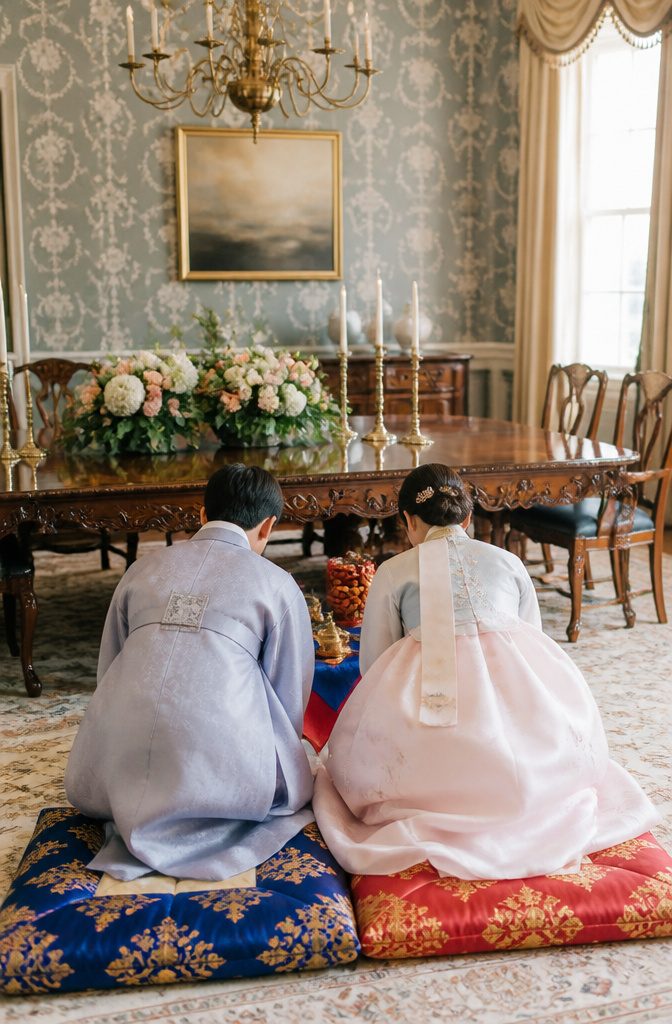
Estate ballrooms and gardens were built for European ceremonies, not for the tea ceremony a bride’s grandmother has performed at three generations of weddings. The space constrains the ritual, and that tension is where the photographer earns the fee.
A Korean pyebaek needs floor seating and a low table. In a historic dining room with carved mahogany chairs bolted to the parquet, the couple improvises on cushions in a corner.
The photographer who planned for this shoots from the height of the bow, not standing over it, so the image reads as ceremony rather than concession. The estate’s grandeur becomes backdrop instead of obstacle.
Some traditions require fire. A Hindu havan or Chinese ancestor lighting in a plantation house with smoke detectors and a strict preservation board demands negotiation weeks ahead.
The photographer should scout where the vents are, where the light falls at that hour, and whether the couple wants the modern sprinkler head in the frame or cropped out.
Most couples I have worked with choose honesty over staging; the sprinkler stays, and the image documents what it cost them to honor both grandmothers and the venue’s rules.
The best estate wedding photos of cultural ceremonies do not hide the mismatch.
They frame the adaptation: the sari against the Federalist wallpaper, the mariachi brass section squeezed between Corinthian columns. The camera finds the hand adjusting a generations-old cloth to fit a foreign chair.
Frequently Asked Questions
What are the best photo locations at The Morris Estate?
The vintage Chapel gives ceremony portraits a timeless, intimate backdrop, while the Tent’s open, light-filled design works best for reception photography. Most couples use both spaces through the day, which gives the final gallery real variety without leaving the property.
How do I choose the right estate venue for my wedding?
Start with guest count, since capacity limits often decide the photography style before you do.
Then weigh the five attributes that matter for images: architectural style, indoor-outdoor balance, built-in amenities, and the scenery surrounding the property. A historic manor capped at 75 guests forces a different rhythm than a working farm that holds 300.
What are some unique ideas for personalizing my estate wedding?
Bring details that the estate’s textures can answer rather than swallow. Dried petals tossed down a stone aisle gain gravity against limestone; a grandmother’s ceramic tub styled with rings works when weathered ground answers the glaze.
Place custom pieces where the estate’s own lines are simplest, so hand-painted banners or bar signs stay readable instead of disappearing into carved stone.
Are estate weddings cheaper?
Not inherently. A Georgian mansion suited to grandeur can make twenty guests look like scattered furniture, which wastes money on scale you cannot use.
The real savings come from what the estate already owns: grounds for portraits, built-in bars for cocktail hour, garden structures for ceremony framing. Each removes a rental line item, but the venue fee itself varies widely by region and exclusivity.