Wedding classic photography is the deliberate use of poses that have survived decades of shifting trends because they capture something true rather than something current.
Most of these shots need time built into a timeline that already feels crowded; the dress buttoning moment alone takes five minutes that couples rarely think to protect, and the silhouette lives or dies by whether family portraits ran long enough to kill the afternoon light.
A photographer who has worked more than a handful of mornings knows to stage the buttoning after the dress is already on if zippers jam, because the emotion reads as real even when the timing is adjusted.
The Dress Buttoning or Zipping Moment
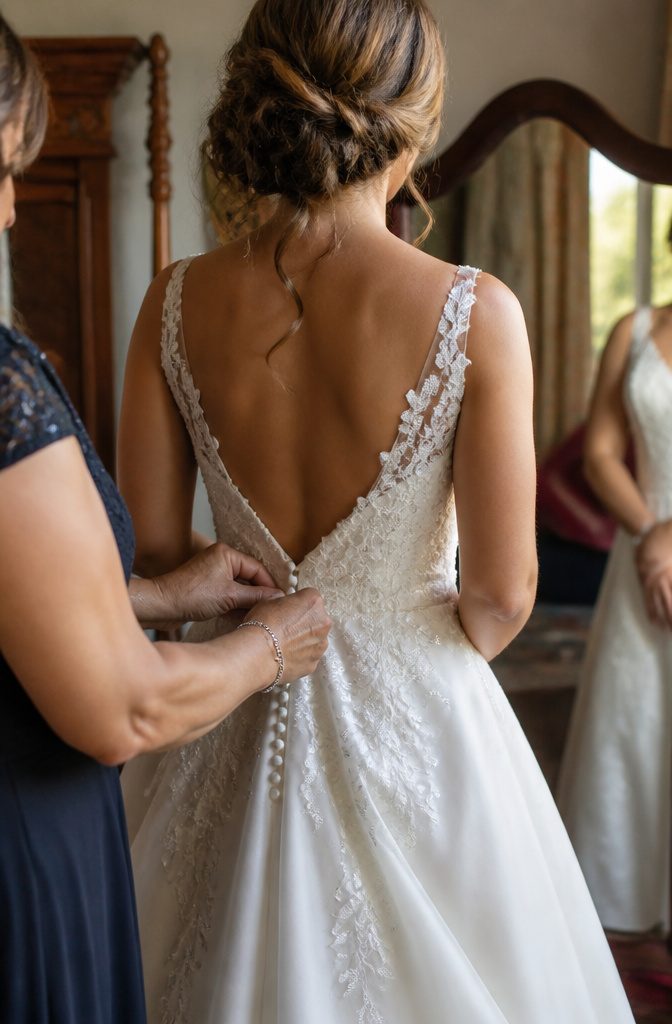
The hands at the back of the dress belong to someone the bride chose to have there, and that relationship is what the camera catches.
This shot is one of the most requested in wedding classic photography, and with reason: the slight lean forward, the fabric gathering, the quiet focus on a task that is purely about help.
It reads as tradition because it is tradition, unchanged across decades of weddings.
The moment can be staged if needed. Buttons stick, zippers jam, and a photographer who has worked more than a handful of mornings knows to capture it after the dress is already on if that is what time allows.
The image still works because the emotion is real even when the timing is adjusted.
On a tight schedule, this takes five minutes that pay back in the album for years. The couple stepping into the gown is not stepping into a trend that will look dated by the first anniversary.
The pose is restraint itself: no backdrop to choose, no prop to coordinate, just the act of being helped into something important.
Bridesmaids Looking Back and Forth
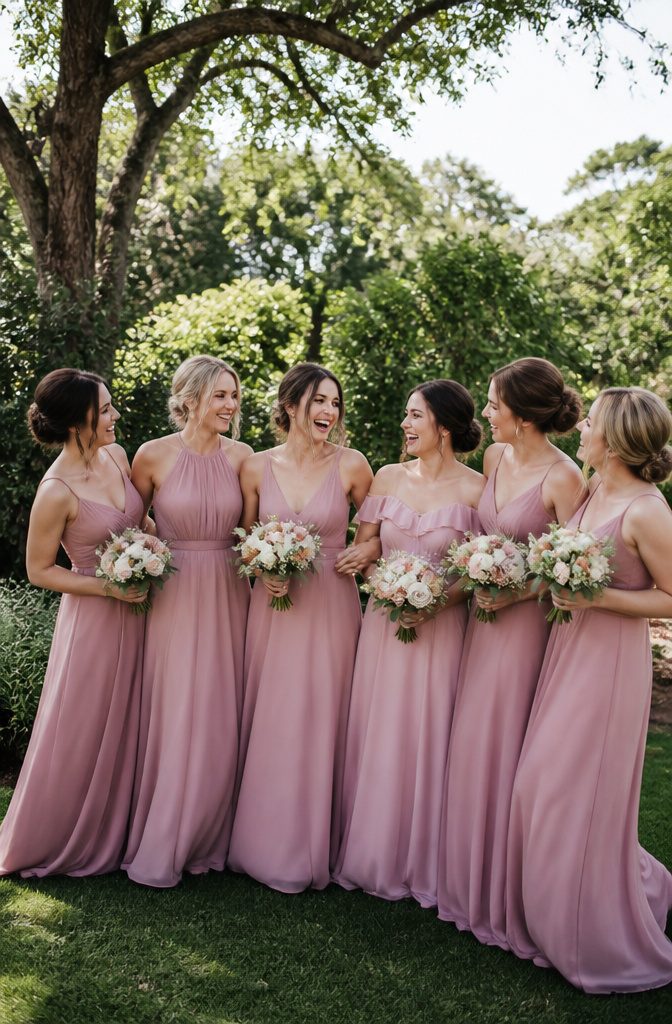
A wall of bridesmaids facing the camera and smiling on cue has its place, but the version photographers still ask for is the one where the group turns inward and looks at each other.
The bodies form the same rough line, but the faces break it. Each woman catches the eye of the one beside her, and the frame suddenly holds a real conversation instead of a lineup.
The trick works with three attendants or twelve.
With a small party, the gap between bodies stays narrow and the glances read as intimate. Add more women and the chain of looks stretches into something livelier, almost a ripple of reaction moving across the row.
Either way, the photographer gets movement in a pose that still reads as formal enough for the album the parents buy.
Photographers set this up because it solves the dead-center problem. Everyone staring forward flattens depth; everyone angled off copies a magazine spread from 2008.
The half-turn keeps shoulders from going identical, gives hands something to do with bouquets, and lets the bride stand at the center without looking like a figurine on a shelf.
I have seen this shot saved in every wedding gallery I have sorted through, and the ones that make the cut are almost never the straight-ahead version.
The Ring Detail Shot on the Groom
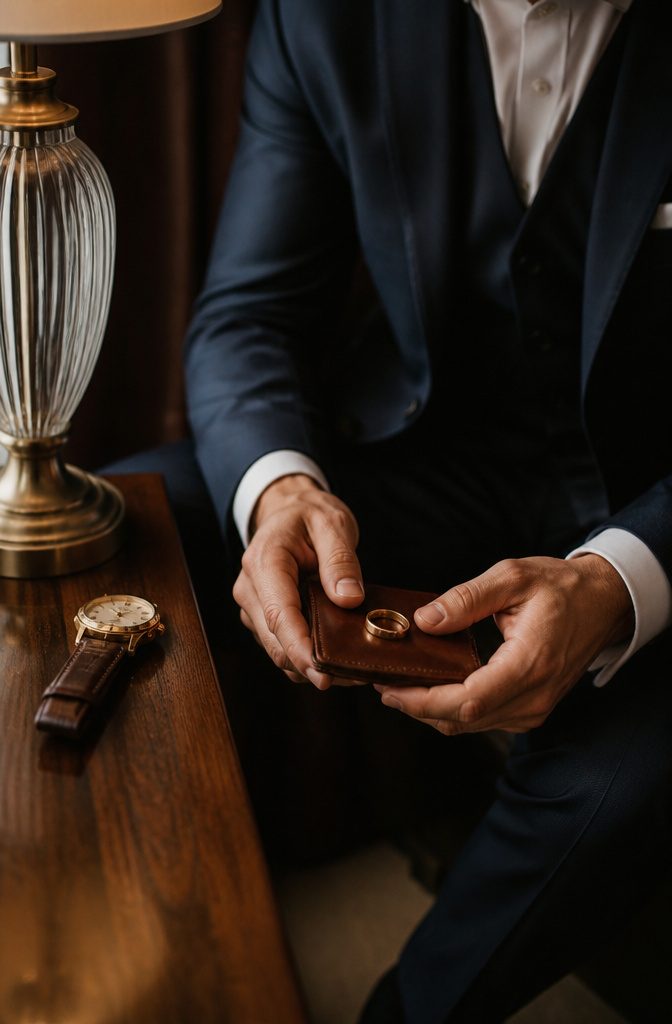
A close-up of the groom’s hands with the ring, shot while he is still getting ready, belongs in every classic wedding portfolio for a reason that has nothing to do with the ring itself.
The metal catches window light differently on a flat surface than it does sliding onto a finger, and the fingers in these frames are relaxed, not performing for an audience.
That stillness reads as private, which is the mood you lose once the exchange becomes a ceremony.
I schedule this during the groom’s getting-ready window, usually after the tie or cufflinks are on but before the jacket goes over everything.
The photographer needs about five minutes, sometimes less, and the best surface nearby is whatever the groom already owns: a watch, a leather wallet, the edge of a handwritten note.
The hands do the work; the ring is just the excuse to look at them.
What separates this from the ring-exchange frame is anticipation versus event. One is a promise still in the pocket.
The other is a promise kept. Both matter, but only one gets the unguarded texture of skin before nerves set in.
For couples working with a modest photography package, this shot also buys time: the photographer captures detail while the groomsmen finish their own prep, so nothing in the schedule stalls.
All the Veil Shots
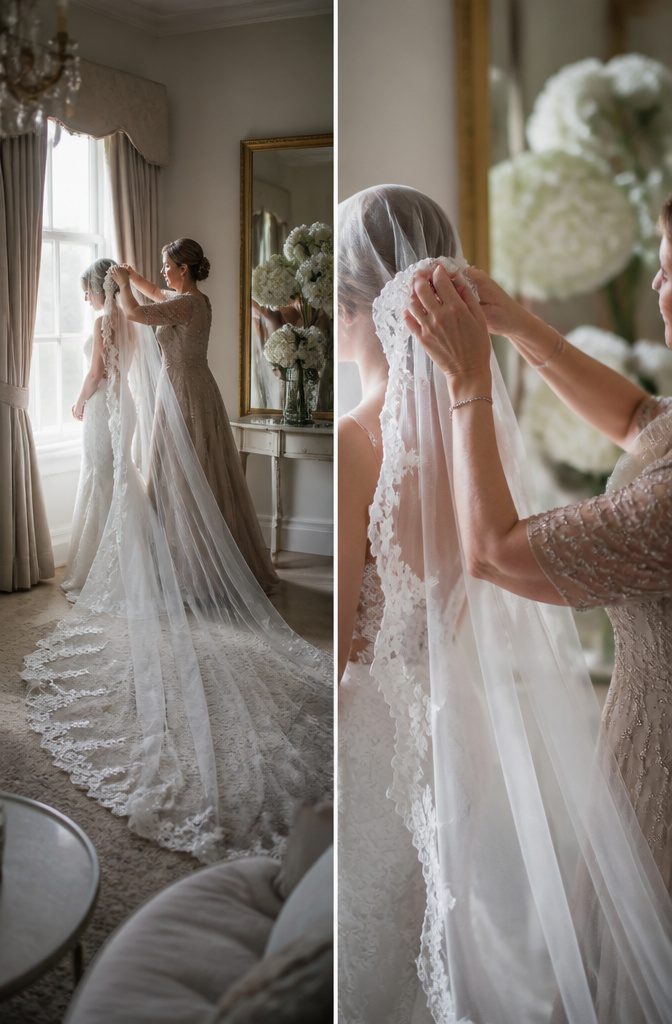
The veil gives a photographer three natural beats before the ceremony even starts.
A mother lifts it into place, the bride checks the fall in a mirror, and the full portrait with the veil down frames the face in soft tulle.
Each shot reads as tradition even when the couple plans a modern service.
Brides increasingly skip the veil for the ceremony itself, which makes these pre-wedding frames more valuable, not less.
The photographer who waits for the ceremony to capture veil imagery often misses it entirely. Schedule the portrait with the veil down during getting-ready, when the light is still controllable and the bride has not yet shifted into processional adrenaline.
The fabric itself does the compositional work. It adds movement where a static portrait would flatten, and it softens window light across skin in a way no diffuser mimics exactly.
A long cathedral veil trailing behind the bride turns a standard hallway into a leading line without the photographer arranging a thing.
I have watched photographers treat the veil as an afterthought and then struggle to make it look intentional later. The shots that last are the ones built into the timeline, not grabbed in passing.
Beneath the Veil
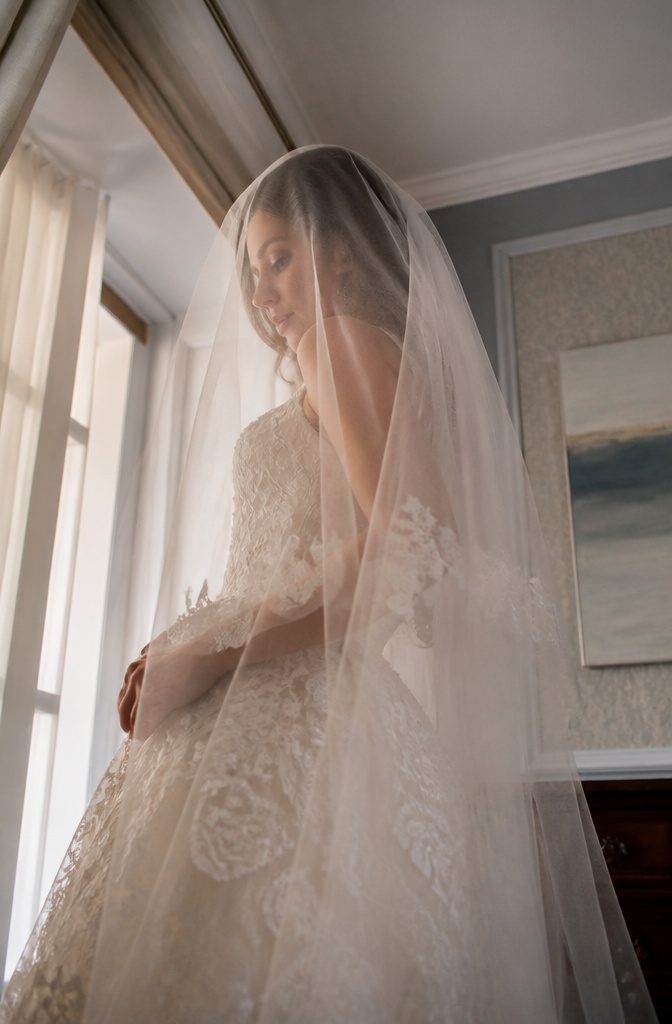
The shot from beneath the veil asks the photographer to lie on the floor or crouch at knee level while the bride holds the fabric just clear of her face.
Light has to pass through the tulle or lace at a shallow angle, which means the material goes from translucent to opaque in a matter of inches.
Most photographers meter for the bride’s skin and let the veil fall half a stop darker, but if she tilts her chin even slightly the shadow across her eyes turns the frame into a silhouette.
The bride looking down through the veil works more reliably than looking up at her, since the floor bounce fills the shadows and the photographer keeps both feet.
Setup takes longer than couples expect.
Someone has to arrange the veil so it does not bunch like a curtain, the bride has to freeze a pose that feels theatrical, and the light has to be checked from an angle nobody naturally views from.
Yet it persists because the result inverts the usual wedding perspective. Guests see the bride from across the room; this frame puts the viewer where only the bride herself stands.
The slight diffusion flatters without the soft-focus gimmickry of older styles, and the enclosed space of the fabric reads as private even in an album shared with two hundred people.
I have watched photographers skip it when the getting-ready room has white carpet or when the timeline slips twenty minutes behind.
The couples who get the image are the ones who saw it in a parent’s album and asked for it by name, budgeted the time, and did not mind looking slightly ridiculous for ninety seconds.
The Just-Married Moment After Everyone’s Watching
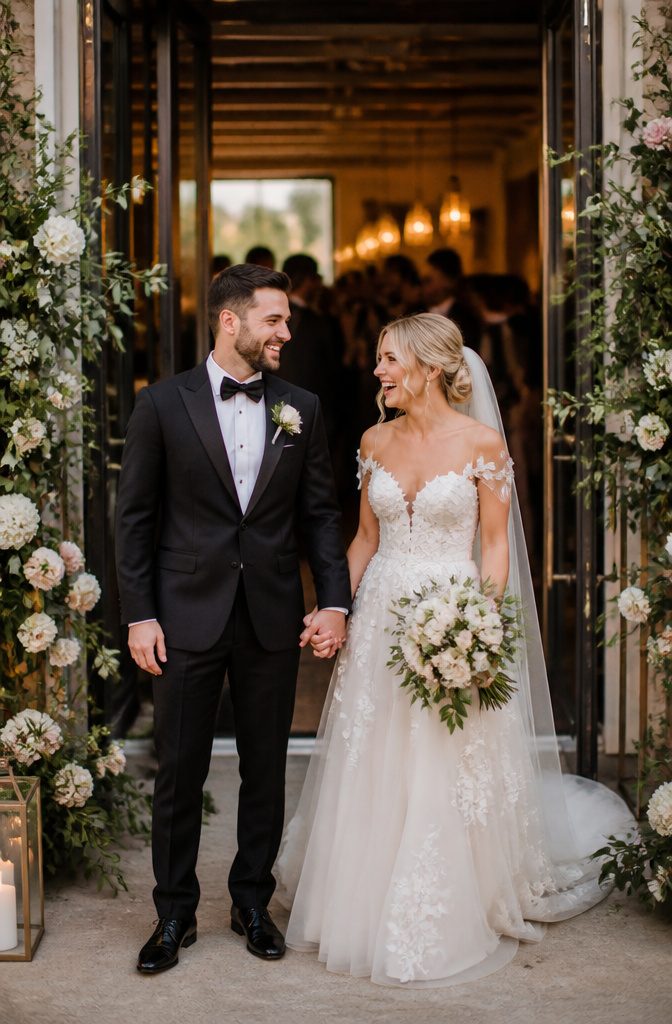
The ceremony exit shot gets all the attention: the flower petals, the cheering guests, the big motion down the aisle.
But the private portrait that follows is where the real emotion lives. Once you’ve walked through those doors and everyone’s still inside, you get roughly thirty seconds before the next thing pulls you away.
Photographers fight to protect that pause because it’s the only time all day when you’re actually married and nobody is asking anything of you.
This is not a posed moment, or at least it shouldn’t feel like one.
You’re still reacting. Relief and disbelief and this specific kind of joy that comes from the thing finally being real, it all shows up unscripted.
The best photographers step back and let it happen rather than directing it into something prettier but less true.
The difference matters for your timeline.
That exit shot is public, performative, shared with every guest and their phone. The just-married portrait is the inverse: just the two of you, still in ceremony light, still wearing the expressions you actually had.
Build the buffer in. Even ten minutes changes whether your photographer gets something you’ll frame or something you’ll scroll past.
The Ceremony Exit
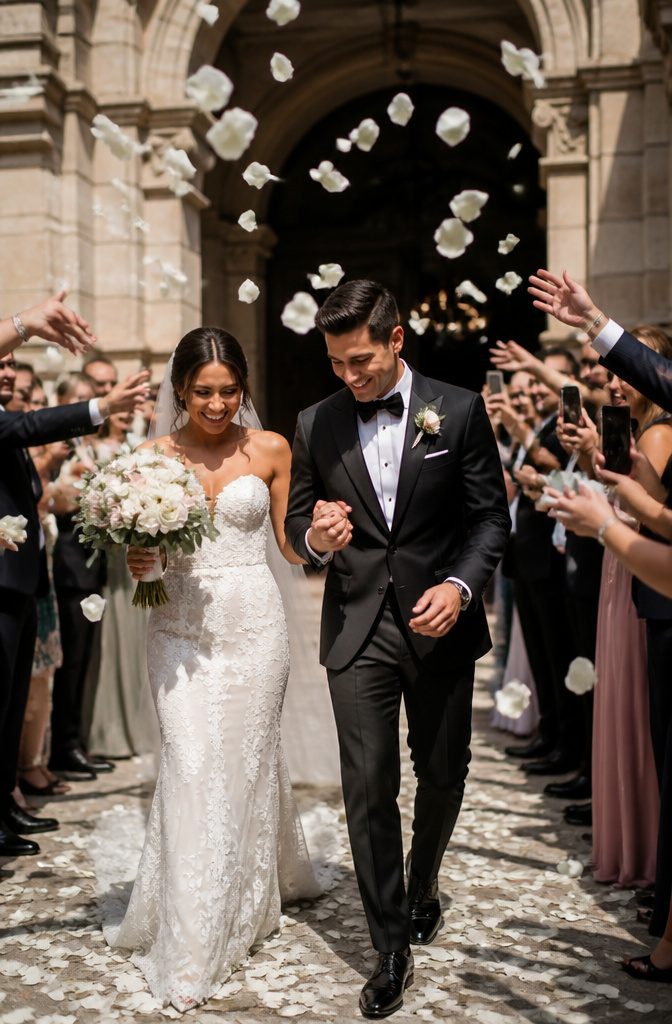
The recessional is the first moment the couple exists as married in the eyes of everyone they know, and the photograph of that walk back down the aisle carries weight no staged shot can replicate.
Guests are standing, some are already reaching for petals or rice, and faces show the release of the tension that built through the ceremony. A photographer who misses this is missing the emotional peak of the day.
What sinks the shot is almost always timing, not technique. The couple turns, takes three steps, and the guests rise in a wave that blocks the aisle view.
The second photographer, if there is one, is often still at the front capturing the officiant’s face or the parents’ reactions. By the time they reposition, the couple is halfway to the door and the composition is lost.
Assign one shooter to the rear of the aisle before the vows conclude, with a clear sightline and a lens already chosen for the distance.
The front photographer stays on the couple’s faces as they turn, then the rear shooter carries the sequence through the exit.
Venues with strict no-throw policies for rice or petals sometimes still permit biodegradable confetti or nothing at all.
The photograph works either way; the gesture matters more than the material. What breaks the image is the couple looking back to check if the photographer caught it, which reads as uncertainty rather than joy.
A quick word during the rehearsal, or a trusted bridesmaid positioned to cue the couple forward, keeps eyes ahead and the stride natural.
The Celebration Pose
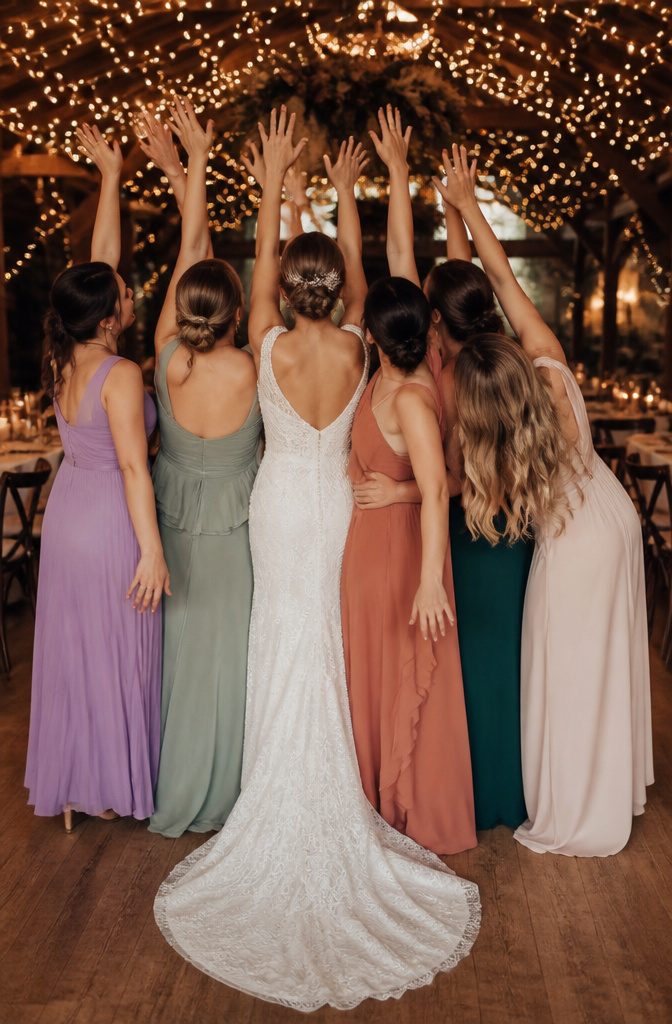
The raised-arms shot works best when the wedding party has loosened up, usually after the ceremony or during the reception entrance.
By then the formal portraits are winding down and people have had enough champagne to forget they are being photographed.
I ask the group to cheer toward each other rather than the camera.
The bodies turn inward, the shoulders drop, and the laugh becomes real instead of performative. One person inevitably throws a hand too high or leans back too far, and that small imbalance is what keeps the frame from looking staged.
This pose sits at a useful pivot point in the day’s coverage. It reads as candid joy to the couple who chose it, yet it gives the photographer a composed group with faces visible and light controlled.
I schedule it right after the family formals, while everyone is still gathered and before guests scatter to cocktail hour.
The transition lets me put the camera down for a few minutes, too; the energy shift from posed to playful happens in a single frame, and the rest of the reception unfolds from there.
Flowers Around the Neck
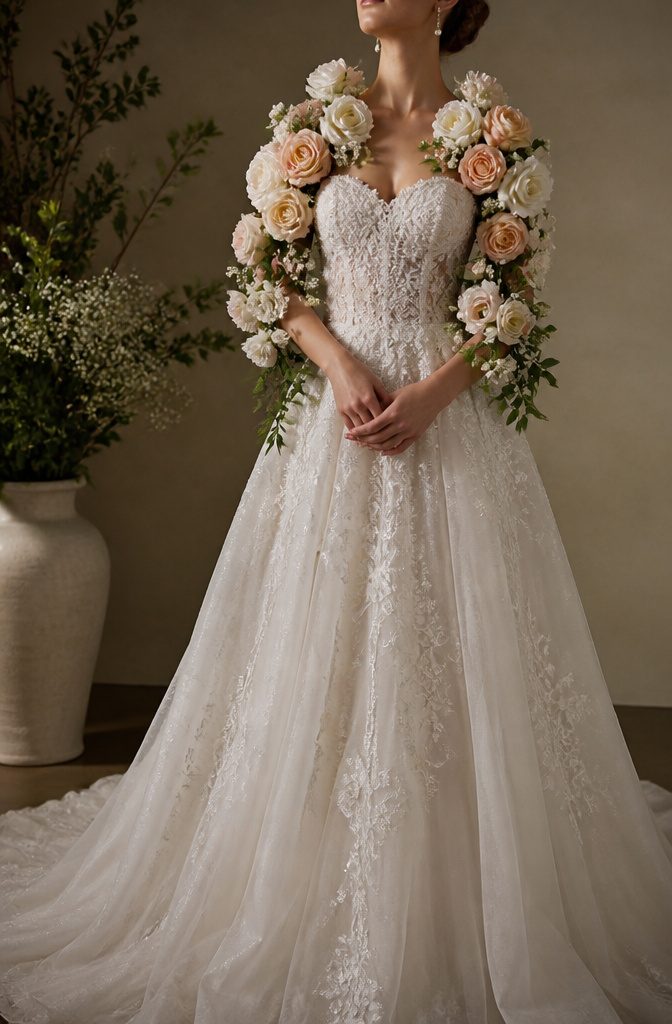
The bouquet at the collar reads straight out of a 1950s studio portrait, which is exactly where it came from. Back then, photographers posed seated women with flowers held high to elongate the neck and catch light on the face.
Wedding photographers kept the frame because it puts the dress neckline and any beading or lace in full view, something waist-level or floor shots rarely manage as cleanly.
Some couples now skip it, calling the pose stiff or old-fashioned.
That is fair. The arms-forward position can look defensive if the bride is not relaxed into it, and it does nothing for movement or emotion the way a walking shot does.
Still, it stays on shot lists for a reason.
When the dress has detail worth documenting, the collar placement gives the fabric center stage without requiring the bride to turn or bend. A good photographer will ask for it quickly, maybe 30 seconds, then move on.
The pose works best as a bridge between getting-ready candids and the more dynamic portraits outside. Ask yours to keep it optional rather than mandatory, and use it only if the neckline deserves the spotlight.
The Silhouette Shot
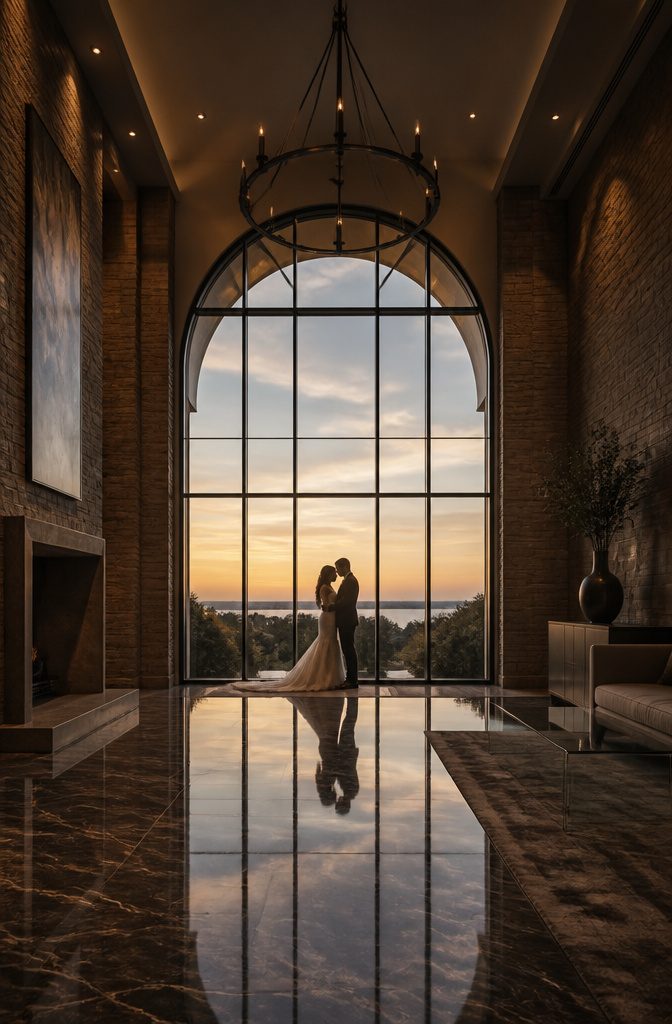
A backlit silhouette reads as classic wedding photography because it does not ask the couple to perform.
The pose itself is simple: two people standing close, often at a window or in an open doorway, turned to profile or facing each other so the camera catches the shape of a gown, a sleeve, the line of a jaw.
What makes the image is the light behind them, usually late-day sun or a bright sky, and the camera exposing for that background so the subjects fall to near-black.
The result is readable in an instant, the way a good portrait should be, and it does not depend on trend or heavy editing to land.
The window of time is narrow. This shot needs the light to be bright enough behind and soft enough not to flare the lens into mush, which on most wedding days means late afternoon.
If the schedule slips, if family portraits run long or traffic stalls the couple’s arrival, the sun drops and the silhouette either loses its clean edge or disappears entirely.
I have seen timelines where this was the planned hero shot of the portrait session, and by the time the couple was free, the background had gone gray and flat.
The photographer had to skip it or fake it with artificial light, which rarely carries the same weight. Build the buffer in, or accept that this one lives or dies by the clock.
Walking and Running Together
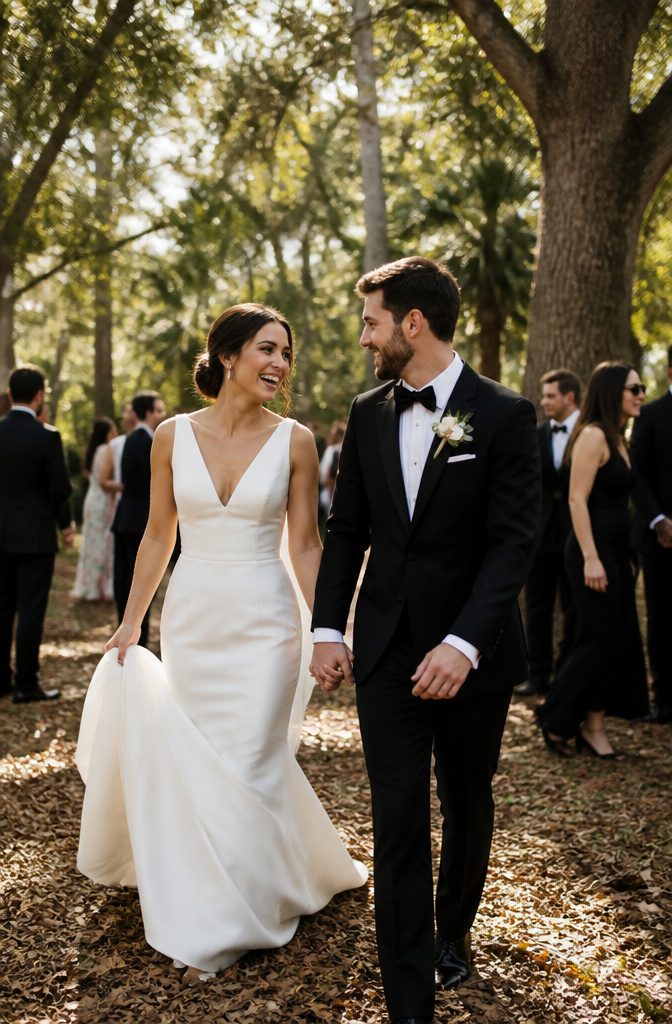
Motion in wedding classic photography still needs a director.
The photographer who tells you to walk the length of the garden path three times is not replacing candids with staged shots; they are building the sequence your album later depends on.
A single frame of you mid-stride reads as a portrait. Four frames in a row, spaced across a spread, read as a story: leaving the ceremony, finding each other, moving toward the reception, the day unfolding.
I have watched couples freeze when a photographer says "just act natural."
The contradiction paralyzes them. The fix is giving the body a job: hold hands, match your pace to your partner’s, look at the ground on step two and up on step four.
These small instructions produce movement that scans as spontaneous because the mechanics are real. Your weight shifts, your dress responds, your hair moves with actual breeze or actual speed.
Running together works the same way, though it risks comedy if the photographer does not set the frame first.
A good one scouts the background for clutter, checks where the light falls at your scheduled time, then asks for a jog rather than a sprint. The result keeps the romantic tone without looking like exercise footage.
Even photographers who sell themselves as documentary-style still intervene this way.
The difference is they intervene on movement instead of position. The album spread still needs that visual rhythm, and rhythm requires enough frames to establish a beat.
The Dip
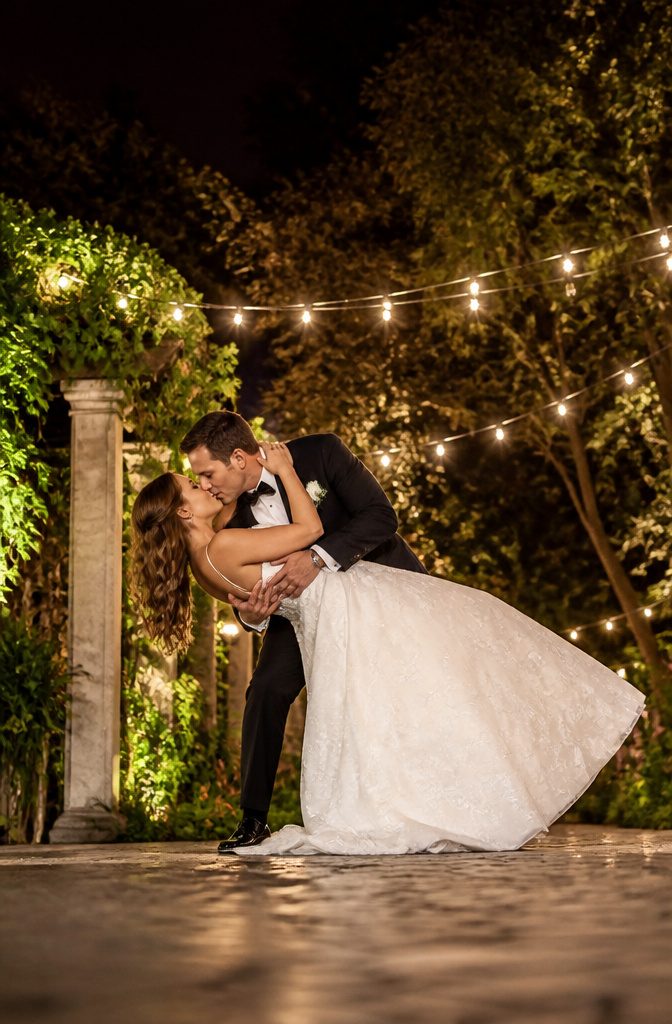
The dip lands in nearly every couple’s must-have list before anyone asks whether they can actually pull it off.
Arching backward while someone else controls your weight is a trust exercise dressed up as romance, and wedding shoes rarely help the footing.
Classic photography keeps this pose alive because the geometry reads instantly: the line of the back, the counterbalance of two bodies, the negative space overhead.
It references every Hollywood kiss and every vintage album in your parents’ attic. That cultural weight is why photographers suggest it even when couples forget to.
What makes it work is coordination, not courage. The partner leading the dip needs a stable base, knees bent, core engaged, one hand at the shoulder blade and the other at the hip.
The person dipping relaxes the neck and drops the weight rather than folding at the waist, which is the mistake that snaps the line and strains the shoulder.
Rehearse it in the shoes you’ll wear, not barefoot in your kitchen. A portrait session leaves room for second takes; a first dance does not, and a wobbly dip under hot lights is a long five seconds.
Most couples who want this shot never mention it outright.
They bookmarked it years ago, or their mother did. Bringing it up early with your photographer lets you practice the mechanics without an audience, and that is worth far more than the pose itself.
Sweet Whispers
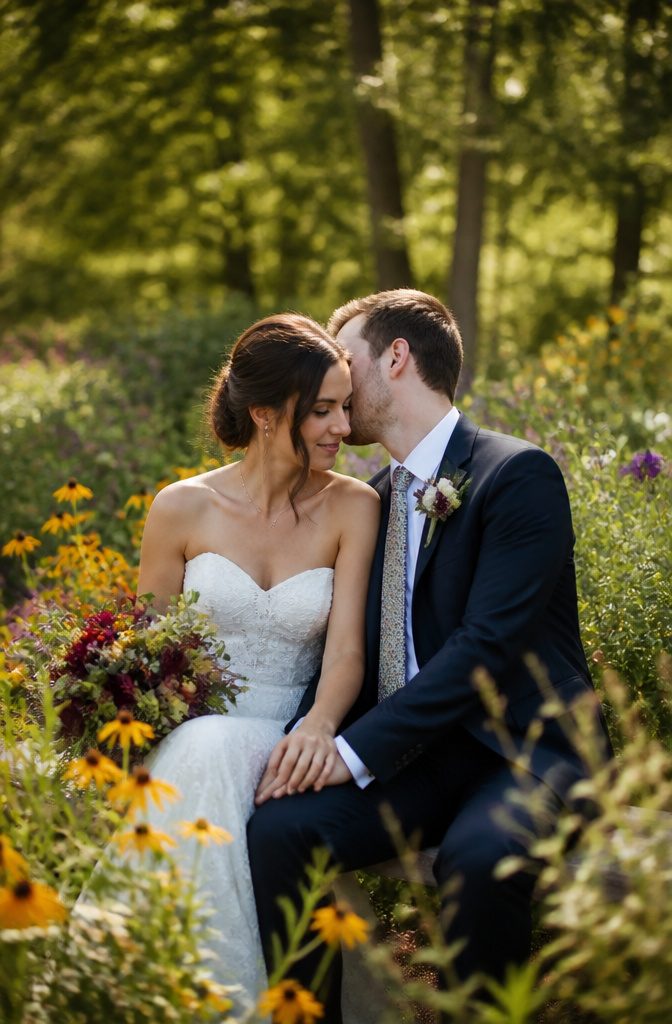
A whispered exchange between partners reads as intimacy even from twenty feet away, which is why photographers set it up rather than hope for spontaneity.
The posture is simple: one person leans in close, lips nearly brushing the other’s ear, while the second person’s face holds whatever reaction comes.
A smile, a blush, a caught breath. The camera gets both bodies close together and two completely different expressions, which doubles the emotional information in a single frame.
The direction matters because real whispered moments at weddings are rare and rushed. The couple is greeting guests, checking timelines, or moving between spaces.
A photographer who waits for candids ends up with shots mid-blink or half-turned away. Setting the pose gives control over light, angle, and the clean background that separates a portfolio piece from a snapshot.
What the pose adds to an album is a private beat in a public day. Most classic wedding photography documents performance: the ceremony, the toasts, the first dance.
The whisper reads as something the couple kept for themselves, even while the camera was there. That tension between exposure and secrecy gives the image weight when the couple pages through years later.
The Slow Dance
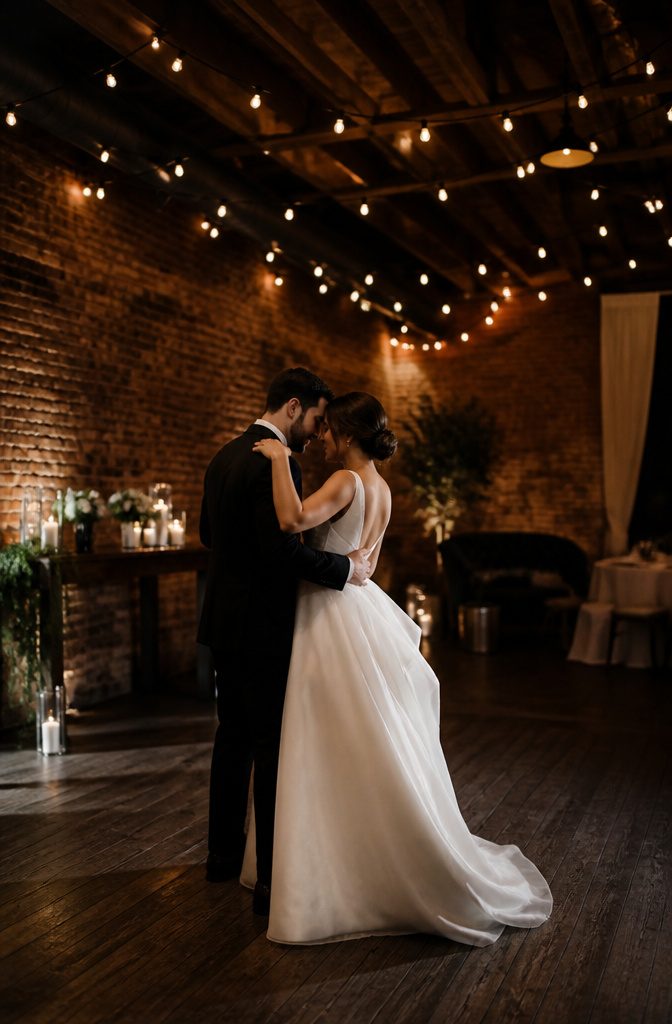
A slow dance pose is shot after the real first dance is already over, usually during a quiet moment when the floor has cleared.
The couple stands in the same hold, but the photographer directs the chin angle, the hand placement, and the gaze. The music, if there is any, comes from a phone speaker or nothing at all.
The background matters more here than it does during the actual dance. Live coverage of a first dance catches the DJ booth, the cake table, and guests cropping the frame with phone screens.
The posed version lets you move the couple ten feet toward a window, a hedge, or a string of lights and hold the shot until no one walks behind them.
The result is cleaner, and the light is chosen rather than accepted.
This image still shows up in classic portfolios even when the documentary frames from the real dance carry more emotion.
The reason is control. A photographer can deliver a print-worthy vertical with symmetry and negative space, something that reads at thumbnail size on a gallery page or in an album layout.
The candid shots may be the ones the couple frames at home, but the posed slow dance is the one they use for thank-you cards and parent gifts.
A Gentle Kiss from the Front
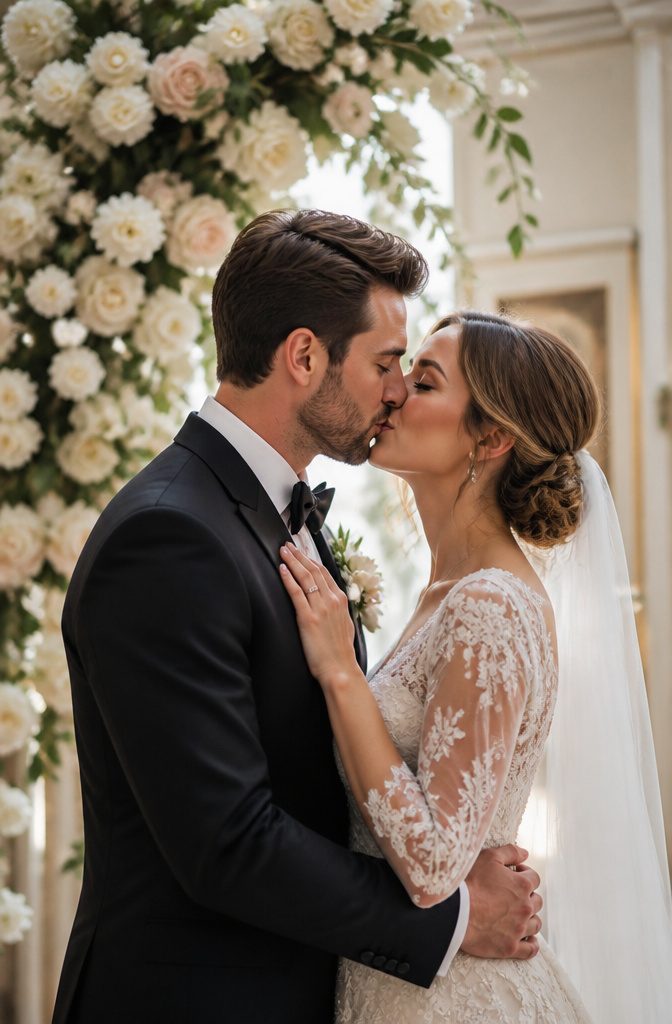
A straight-on kiss during portraits looks effortless in the album, but getting there takes more direction than most couples expect.
The photographer usually sets this up after the ceremony when the pressure is off and you have thirty seconds to hold still.
What separates a classic shot from an awkward one is almost always the chin angle. Tilt one chin up and the other down slightly, so your faces interlock rather than smash flat against each other like cabinet doors.
When both chins stay level, you get a double jawline and no visible neck separation, which reads as two people pressing faces together rather than two people kissing.
I have seen photographers fix this by asking one partner to "reach up" just an inch, which shifts the geometry without making the pose feel staged.
The eyes-closed part matters too; open eyes aimed at the camera turn an intimate moment into a stare-down. The classic version keeps the connection between you two as the subject, not the performance of it for the lens.
Nose Cuddles
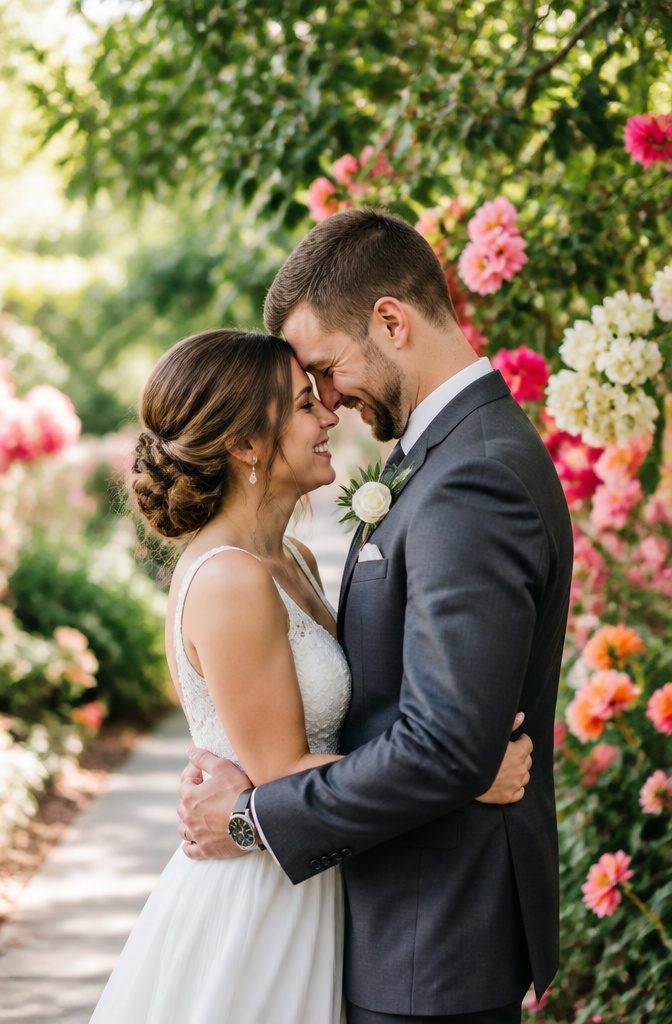
The nose-to-nose pause sits right where a kiss would go, but it trades performance for something quieter. Foreheads stay touching, eyes stay open or fall closed, and the camera catches breath shared instead of lips meeting.
Most couples I watch during portraits tense up when a photographer asks for a full kiss on command. The result reads staged; the bodies lock, the hands go stiff, someone forgets where their nose goes.
The near-kiss solves that. It keeps the intimacy without the pressure to perform it.
This pose belongs in the classic set because it photographs the decision to be close rather than the act of being there.
A century of wedding portraits have used it for couples who laugh at themselves, who need a beat to settle in, or who simply prefer private affection stayed private.
The inches between faces give the photographer a focal plane that sharpens both eyes at once, something an actual kiss rarely allows.
I ask couples to breathe out slowly while their noses rest together. The shoulders drop, the mouths soften, and the image stops looking like a pose at all.
Standing Opposite to One Another
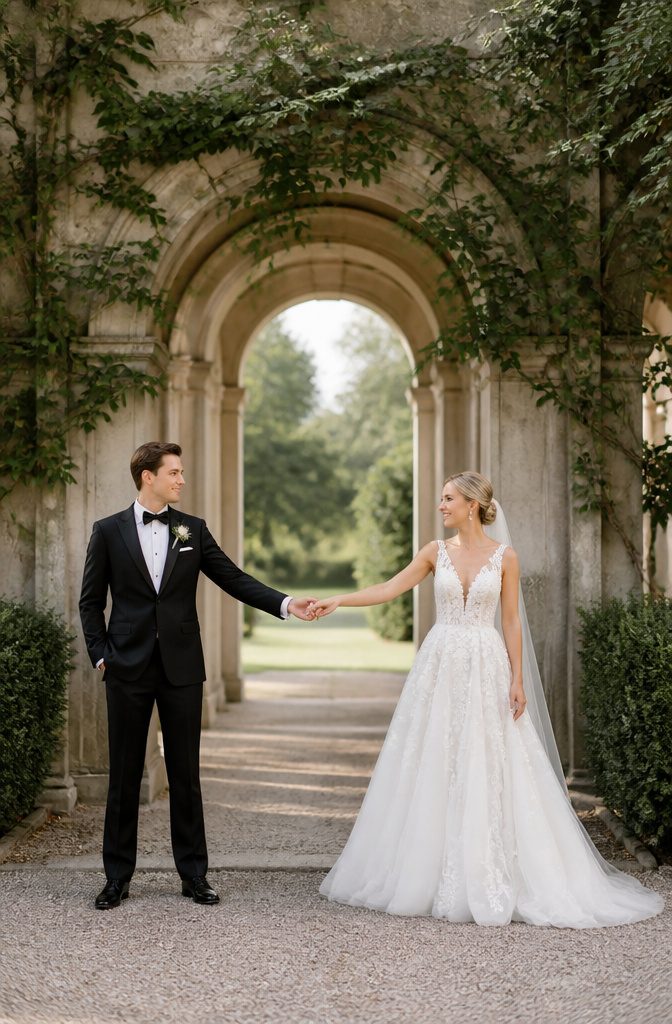
Standing opposite each other, hands linked at roughly arm’s length, puts the full length of both outfits in frame without needing any awkward angling.
The symmetry flatters almost every venue backdrop, from altar arches to open fields, because the eye travels straight to the center and rests there.
I have seen this pose pull focus in family formals where the couple needed to look intentional but not theatrical.
Some couples find the stance reads more contractual than romantic, like a business agreement being photographed rather than a marriage. The formality that makes it timeless also makes it feel stiff to anyone who wanted their photos to look spontaneous.
If you are budgeting for a shot list, ask whether this one earns its place against a candid alternative; with photographers charging hourly, ten minutes on a pose that feels wrong to you is ten minutes lost.
I would still keep it on the list for the album spread where grandparents lean in, but I would not force it on a couple who light up only when they are in motion.
The Power Couple
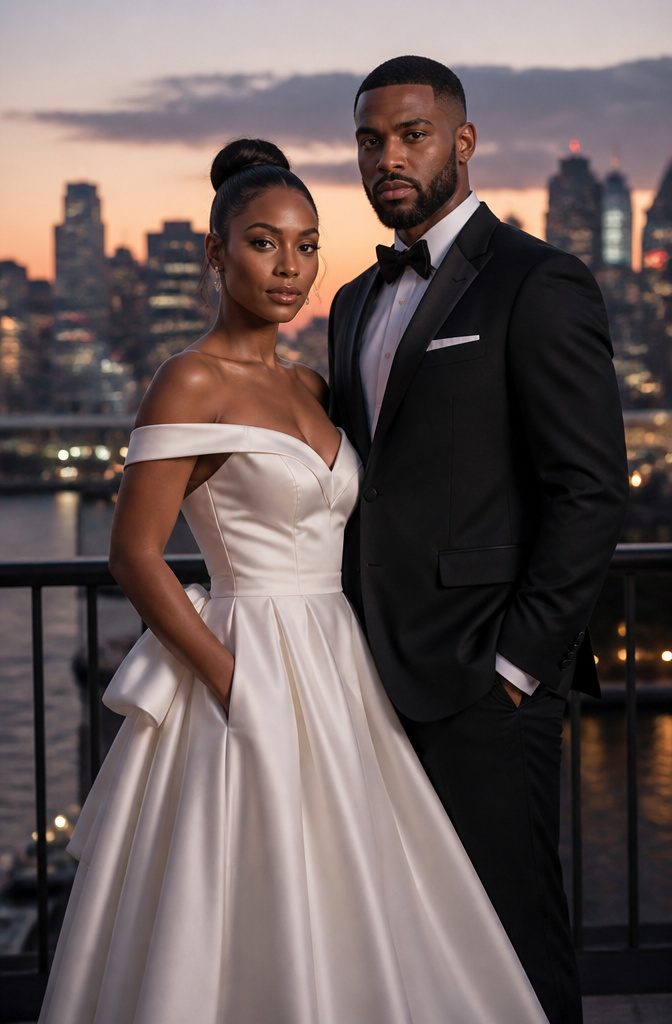
The classic couple portrait, shoulders squared to the lens with both faces fully visible, reads as formal the instant you see it. That stiffness is the point.
Unlike the walking shots or the laughing candids that fill most wedding albums, this pose announces that the couple chose to stop and be photographed. The posture signals intention, not accident.
I used to worry this look felt too yearbook, too posed against a modern taste for "authenticity."
Then I watched a bride use hers for the thank-you card and saw the difference. A casual profile shot, pretty as it was, made her look like a guest at her own party.
The direct portrait let her meet the relatives who had traveled, the coworkers who had sent gifts, with the same steady gaze she held at the altar.
For birth announcements and holiday cards that follow, the format keeps working because the faces are readable at postcard size and the composition stays balanced whether you print 4×6 or scale to a newspaper submission.
The staging is not a flaw to hide. It is the choice that lets the photograph serve a purpose beyond the album page.
Forehead Kiss
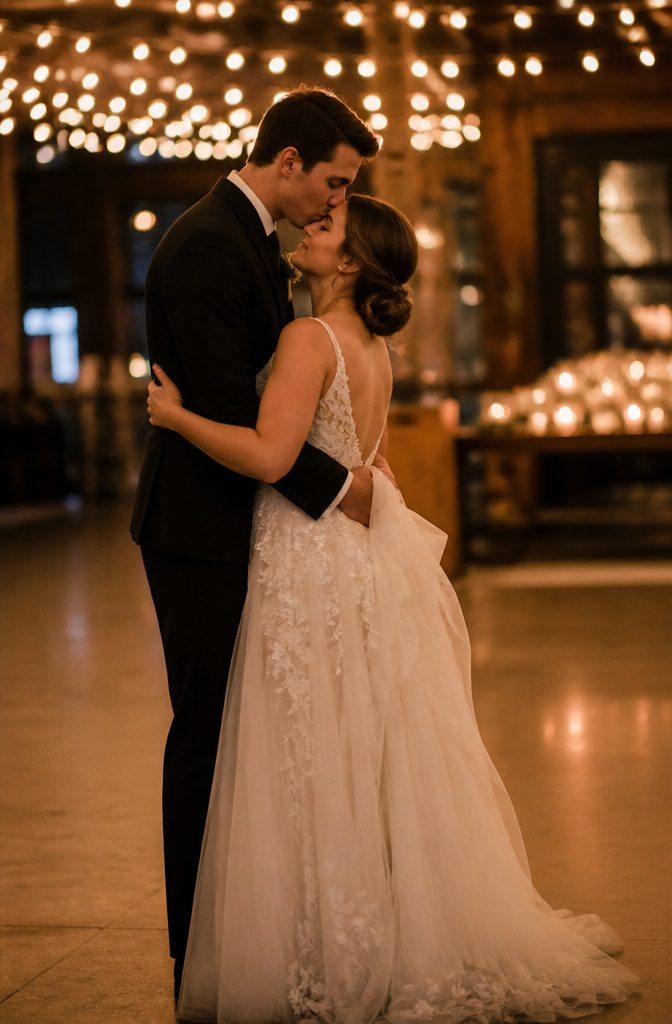
A forehead kiss reads on camera the way a lip kiss rarely does: tender without performance, intimate without the risk of a missed connection or an awkward nose bump.
The gesture itself signals protection and quiet devotion, which is why photographers have kept it in the classic rotation for decades.
The practical advantage is focus. A lip kiss demands both faces be visible and aligned, which collapses when one partner is significantly taller.
The forehead kiss solves this cleanly; the taller partner simply tilts down to meet the other’s brow, and the height difference becomes part of the composition rather than a problem to fix.
Most photographers will place the shorter partner slightly forward or have them lift their chin a breath, but nothing elaborate is needed.
Keep the eyes closed for the shot, not squeezed but softly shut.
The difference between a forehead kiss that looks staged and one that looks felt is usually in the face being kissed; relaxation there reads as trust, which is what the pose is meant to capture.
The Look Back
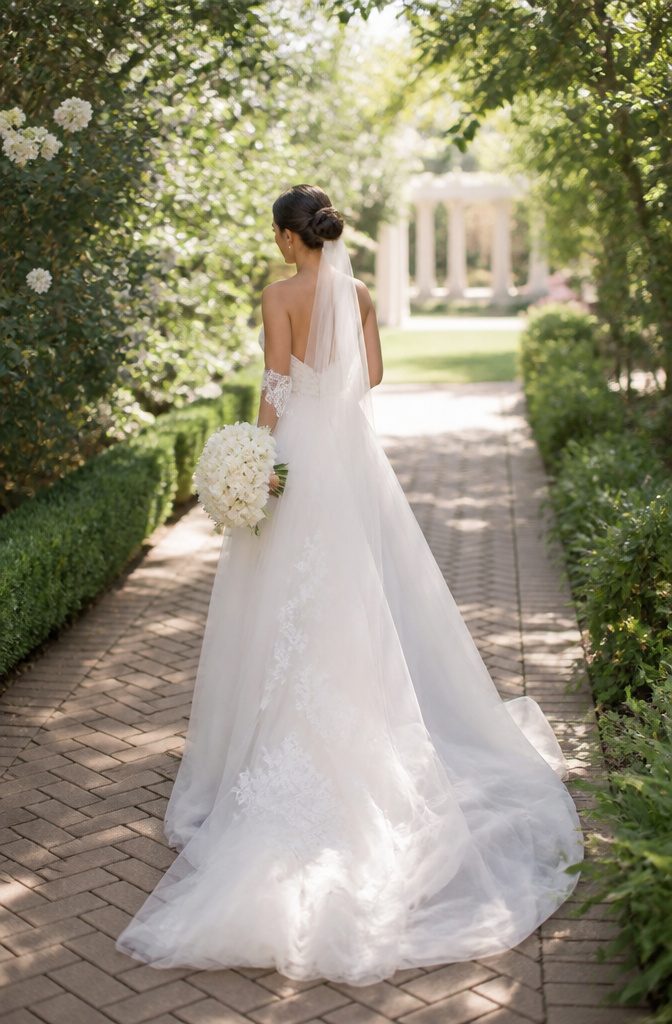
The over-the-shoulder glance survives in nearly every classic shot list because it borrows straight from film grammar.
The bride turns her head while her body continues forward, the dress train trailing behind her, and for a moment the photograph reads as a paused movie frame rather than a still.
That slight separation between where she is walking and where she is looking creates tension that a straightforward portrait rarely manages.
This pose needs a clean background and real space to work. A cluttered hallway or crowded bridal suite kills the effect; the eye goes to the distraction instead of the gesture.
I have seen photographers try to force it in tight hotel rooms where the bride nearly bumps a lamp turning around, and the result looks cramped rather than cinematic.
The best versions happen in long corridors, open lawns, or cathedral aisles where the trailing fabric has room to settle into its shape before she looks back.
The timing matters too. Caught too early, she is just glancing over her shoulder like anyone checking for a car.
Wait half a second past the natural turn, and the neck line strains. That brief pause when she has heard her name called but has not fully squared back around is where the shot lives.
Frequently Asked Questions
What are the must-have classic poses for wedding photos?
The most requested poses in wedding classic photography include the dress buttoning or zipping moment, bridesmaids looking back and forth at each other, the ring detail shot on the groom, veil shots before the ceremony, the just-married moment after the exit, the ceremony recessional, the celebration pose with raised arms, the silhouette shot, walking and running together, the dip, sweet whispers, the slow dance, a gentle kiss from the front, and nose cuddles.
These poses persist across decades because they capture real emotion and relationship rather than trend.
How can I ensure I get the classic shots I want on my wedding day?
Build buffer time into your timeline and communicate specific shots to your photographer early.
Many classic shots, like the silhouette, live or die by the clock; even 10 minutes of protected time changes whether your photographer gets something you’ll frame or something you’ll scroll past.
What is the difference between traditional and modern wedding photography?
Traditional wedding photography centers on classic, posed shots with the photographer directing composition and formality.
Modern photography is more informal and spontaneous, capturing natural moments and emotions as they happen. Even documentary-style photographers intervene on movement rather than position to build visual rhythm for the album.
Is $4000 a lot for a wedding photographer?
It does note that couples working with modest photography packages benefit from efficient shots like the groom’s ring detail, which buys time while groomsmen finish prep.
What matters more than price is whether your package includes enough coverage time to protect classic shots that depend on scheduling, like the late-afternoon silhouette.
What is the 30-5 rule for weddings?
For timing, it emphasizes protecting small windows: the dress buttoning takes 5 minutes, the groom’s ring detail needs about 5 minutes, and the just-married moment after the ceremony gives you roughly 30 seconds before the next obligation pulls you away.
What is the 20/60/20 rule in photography?
Its approach to coverage is built around specific beats rather than percentages: three natural veil shots before the ceremony, a sequence of walking frames for album rhythm, and a single frame versus four frames to shift from portrait to story.