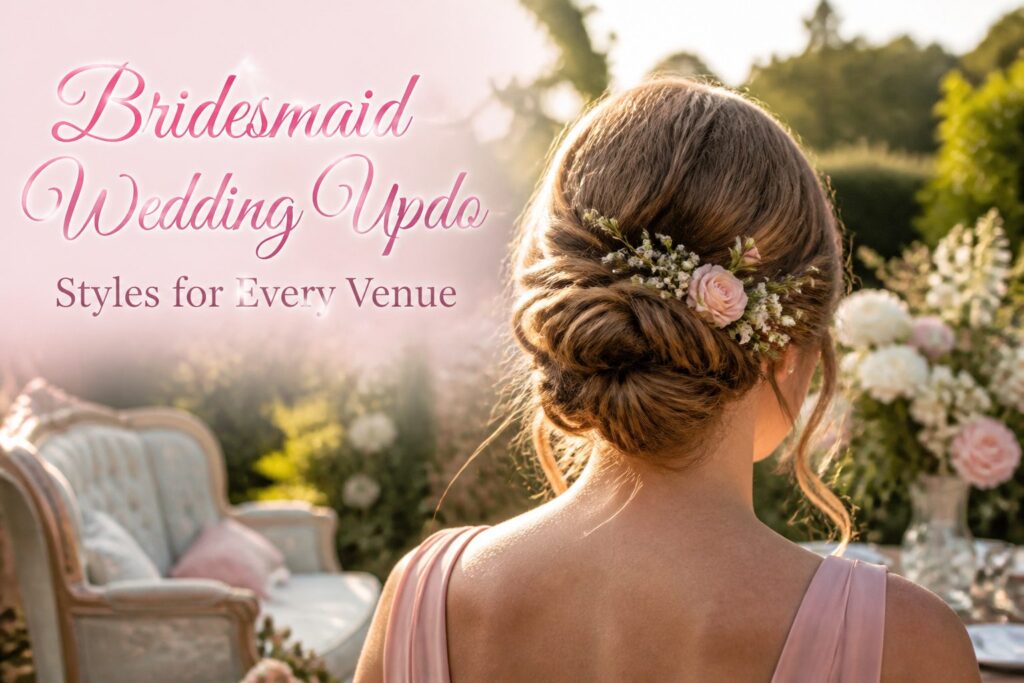
Hair up dos for weddings bridesmaid range from polished low buns that survive twelve-hour days to braided styles that grip slippery fine hair without a single touch-up.
The deciding factor is not the venue itself but the neckline of the dress and whether the bridesmaid wants to spend cocktail hour fixing pins or drinking it.
A single well-made pin at $25 outperforms a set of six lightweight ones that scatter across the dance floor before cake, and the difference between a finished updo and a half-undone one often comes down to keeping face-framing strands no longer than collarbone level.
1. Updo with Face-Framing Hair
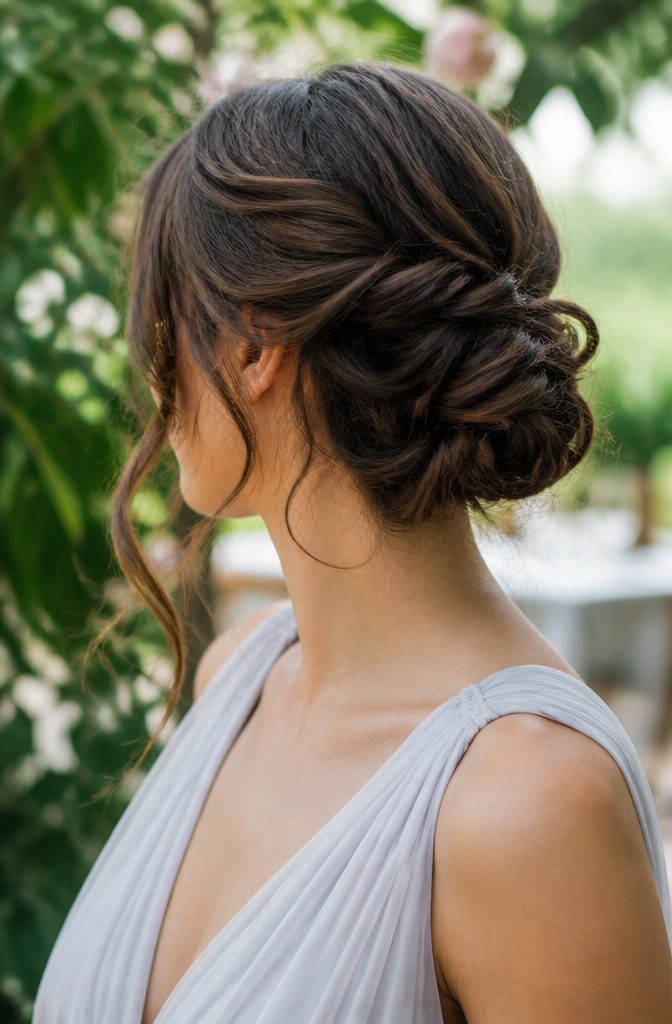
Soft pieces left around the face can turn an updo from strict to romantic in about thirty seconds.
Three top style guides flag this as their leading recommendation for bridesmaids, and the reason holds up: those loose tendrils soften every face shape, from round to angular, because they create a gentle border that draws the eye inward rather than letting the hair pull everything back tight.
Pair the looseness with the dress neckline. A plunging V or sweetheart cut gets enough drama from skin that you want only a whisper of hair, maybe two slim pieces curling at the jaw.
Higher necklines, bateau or illusion styles, can handle more volume in those face-framing sections since the dress itself gives the eye nowhere soft to land.
Keep the strands no longer than collarbone level or they read as half-undone rather than intentional.
Curl them for evening weddings where candlelight catches the movement, or leave them straight and slightly tousled for outdoor ceremonies where wind will do the styling anyway.
Either way, the face-framing detail bridges the gap between the structured updo and the natural texture most bridesmaids actually walk in with, which means less panic in the hotel bathroom and fewer bobby pins failing at the altar.
2. Classic Bun Hairstyle
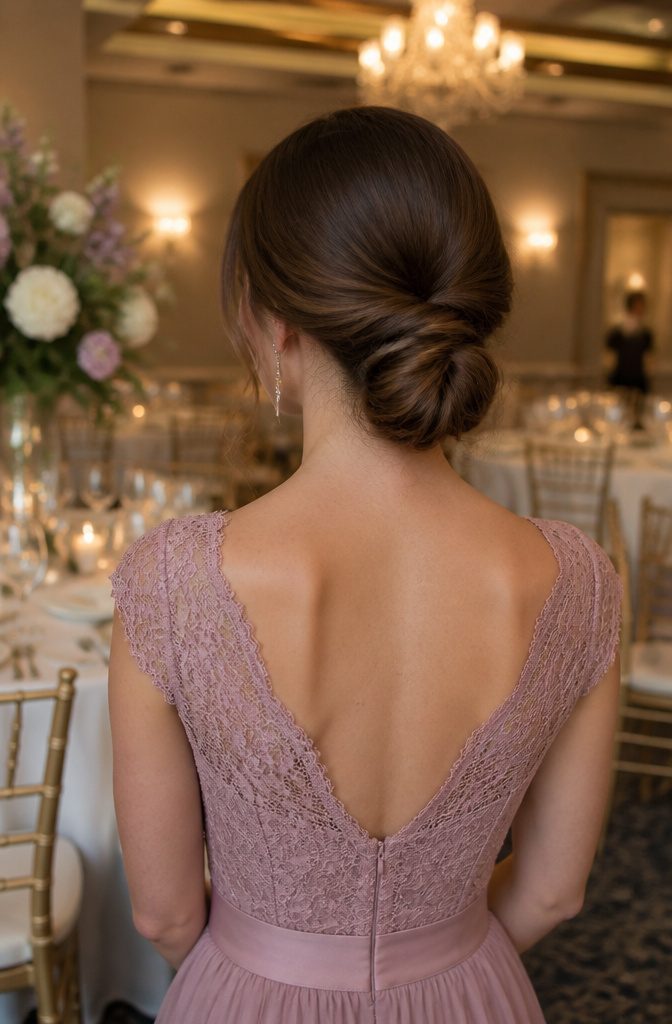
A low, polished bun sits at the nape and stays there.
That is why it has become the default formal choice for bridesmaids: gravity works with it, not against it, and the style traps no heat under stacked curls when the ceremony runs long and the dancing starts late.
I have watched this hold through twelve-hour wedding days without a single pin sliding.
Hair that brushes the collarbone or longer carries it best. Shorter lengths can be worked in, but the finished shape needs enough material to form a smooth, self-supporting coil rather than a padded illusion.
Three takes on the style treat it as the benchmark. One counts the bun as the go-to for simplicity and elegance, wearable high, low, or to the side, with a sleek finish reading polished and a textured finish reading romantic.
Another calls the low bun synonymous with versatility, matching any dress and holding through the reception. A third frames the salon updo as the single splurge-worthy reward of bridesmaid duty itself:
"My favorite part: having no choice but to splurge on a salon updo. What fun to finally make one of the updo ideas I hoard via Pinterest and Instagram a reality."
— Glamour
For the reader booking their appointment, this means the classic bun is the safe bet to request when the bride wants cohesion and you want a style that still looks deliberate at midnight.
3. Messy Bun
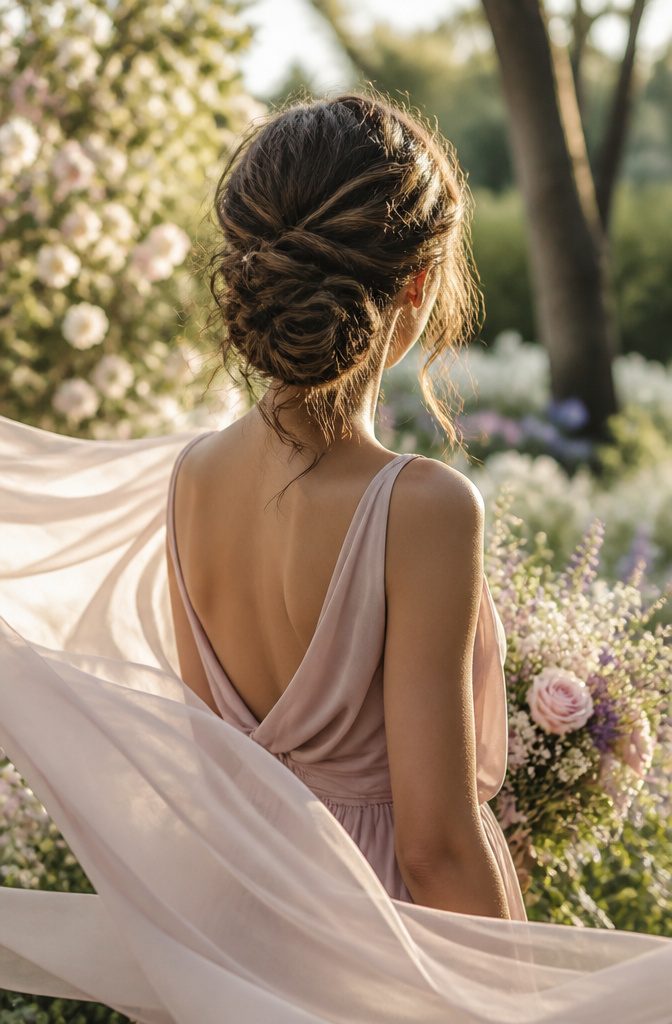
A messy bun only works when the texture is intentional. Loose strands and soft curls create a romantic shape, but the volume underneath has to be built, not hoped for.
Pre-curling the hair gives the pins something to grip, which is why stylists reach for a curling wand or iron before they start pinning.
One video walkthrough notes that the curls do not need to be perfect; their job is to add texture so the finished shape holds without looking uniform.
Backcombing at the crown, sprayed in thin layers, builds the fullness that keeps the style from collapsing into a failed classic bun.
This is the updo I send bridesmaids toward when the wedding has a boho or rustic thread running through it.
The softness pairs well with dresses that have their own movement, like chiffon skirts or lace overlays, and it does not fight a floral accessory.
Owners on Reddit mention that the messier the better is not license to skip structure; the pins still need to cross for security, especially if the day runs long or the venue has humidity to spare.
Dry shampoo at the roots prevents the scalp from looking oily by the end of the night and buys a little extra volume while you are working.
4. Braided Bun Hairstyle
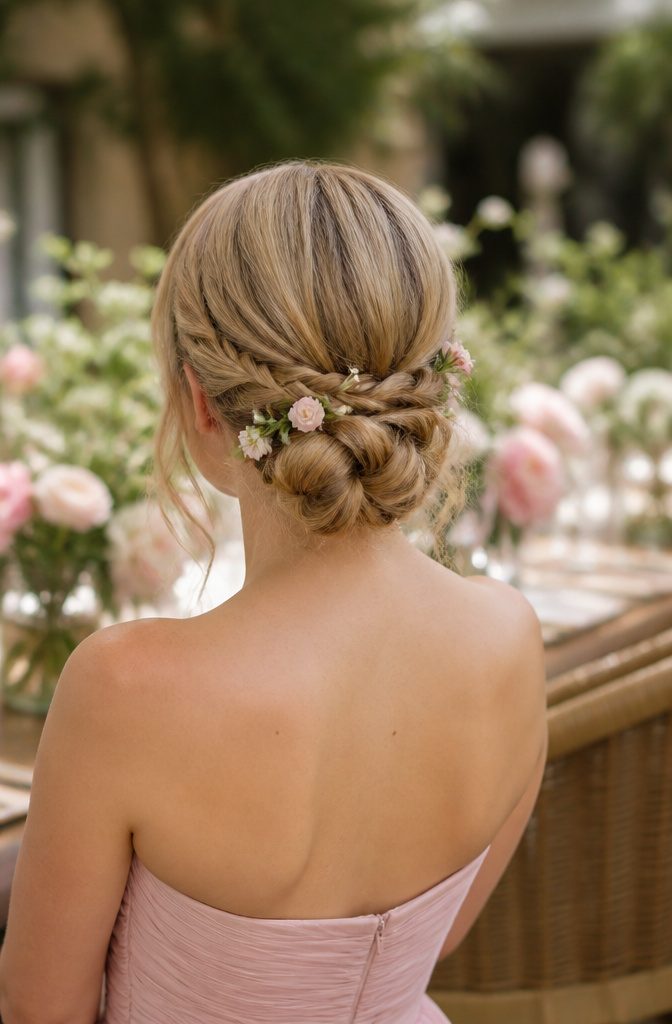
A braided bun does two jobs at once: the braid gives the eye something to follow, and it grips slippery or fine hair that a plain bun would slide out of within an hour.
Three separate style roundups currently rank this combination near the top for bridesmaid work, which tells you how reliably it photographs and how little it demands in touch-ups.
The weave itself can be worked in as decoration or kept hidden as scaffolding. Ribbon threaded through the outer edge reads formal, almost Victorian; small flowers tucked between the plait and the bun feel garden-party soft.
Either way, the braid adds bulk where the hair underneath is thin, so bridesmaids with fine or medium density get the most structural benefit.
Those already carrying thick hair sometimes skip the braid entirely and twist straight into the bun to avoid a shape that overwhelms the neckline.
Placement matters for the overall silhouette.
A low braided bun at the nape keeps the line clean with a strapless or sweetheart neckline. Higher placement works when the dress has detail at the back that needs framing rather than hiding.
5. Half Up With Soft Curls
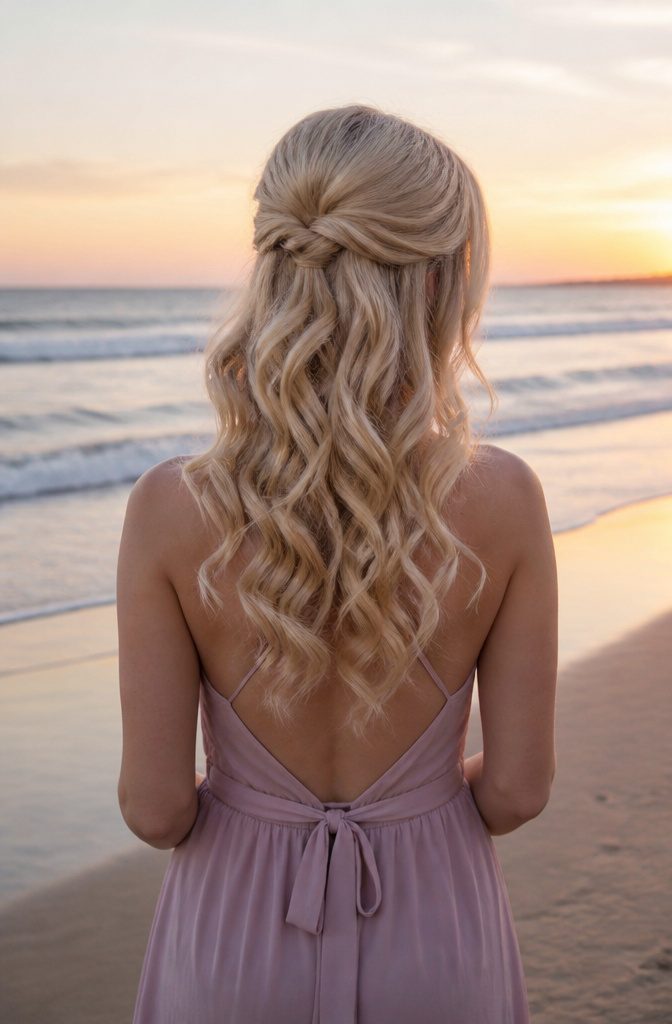
A bridesmaid who wants the polish of an updo without surrendering all her length lands on the half-up with soft curls almost every time.
The style gathers the crown back while letting barrel curls fall below, which means one member of the party can keep her hair mostly down for a beach ceremony and another can still show off a detailed dress back without committing to a full chignon.
The curling work matters more than the pinning.
Sources describe using a large barrel curling iron for natural curls rather than tight ringlets, then twisting the top section back and securing it in loops with a shiny pin or small ornament.
The loops sit at the crown rather than the nape, so the volume stays visible from the front for photos and does not compete with a high neckline from behind.
This is the compromise that keeps a mixed bridal party from looking mismatched. Someone with fine hair gets structure from the gathered top; someone with thick hair gets weight lifted off her neck without the formality of a bun.
The soft curls work with open backs and V-necks alike, though the style flatters a low or detailed back most, since the gathered section draws the eye upward and the falling curls frame whatever the dress does below.
6. Loose Bun With Curly Strands
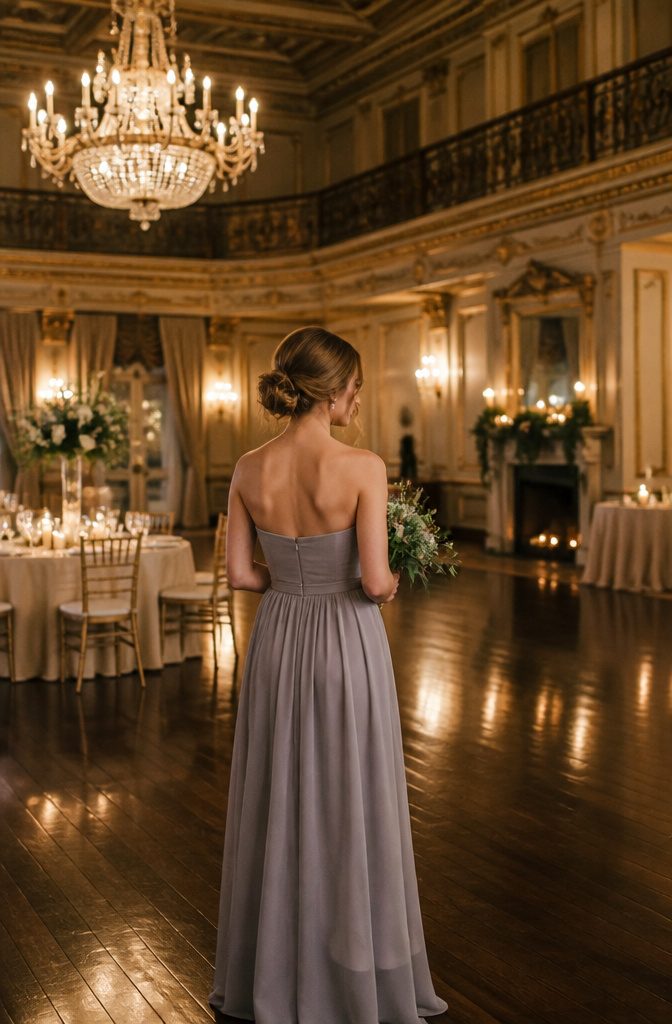
A loose bun sitting low at the nape reads very differently depending on where the wedding happens.
The placement keeps the line of the neck open, which works with strapless dresses and V-necks alike, and the curls that escape around the face soften the whole shape rather than looking like a mistake.
Two approaches define this style: the bun itself stays relaxed but intact, or it loosens into something closer to a messy knot with strands that look spontaneous rather than pinned.
The deliberate curls matter most in how the style translates across venues. In a ballroom or formal church, they keep the look from reading too casual; the structure of the bun still carries the event.
Move the same style outdoors to a garden or barn, and those face-framing pieces pick up wind and light in a way that feels intentional to the setting rather than underdressed.
Soft tendrils read as dreamy and universally flattering, though hair-to-hair formality only belongs where the theme demands it.
Accessories need restraint here.
Delicate hairpins or a single small floral piece sit where they will not compete with the escaping curls. Anything heavier, and the balance tips toward unfinished rather than relaxed.
7. Boho Waves With Flowers
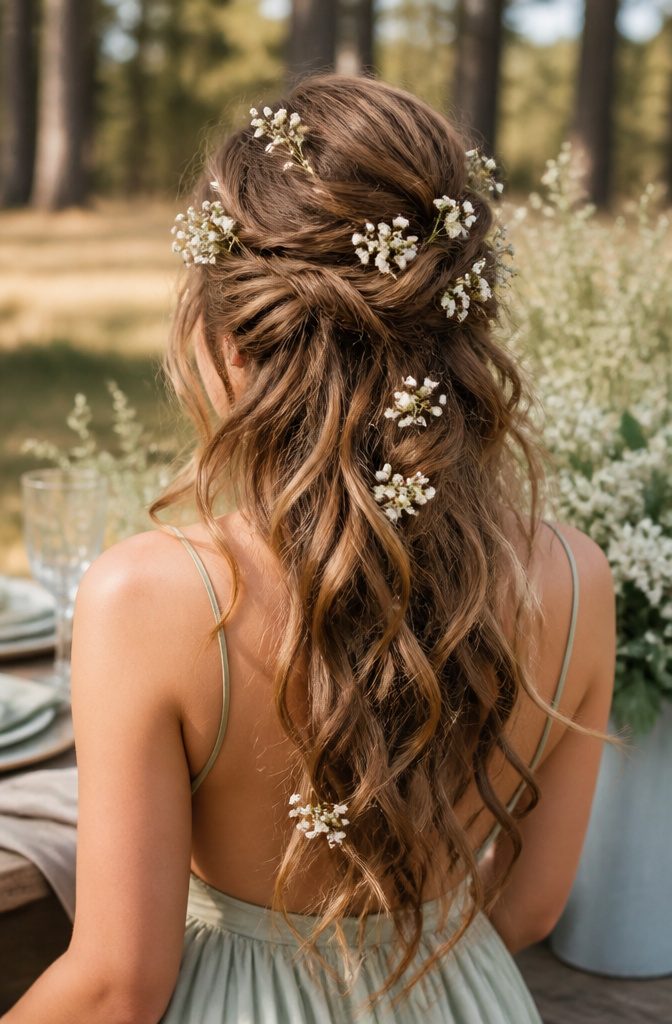
Loose curls mixed with straighter sections build the flowing texture that carries this look, and the flowers sit where they catch light rather than where they fight the shape.
Fresh or dried, the placement matters more than the bloom: a small cluster tucked above one ear reads intentional, while a crown of scattered stems can tip into costume.
Seasonality governs the choice more than most bridesmaids expect. Spring and summer weddings draw from what is actually growing, which keeps costs reasonable and colors honest.
Fall and winter ask more of dried options or forced greenhouse stems, and the palette shifts toward muted tones that photograph differently against late-afternoon light.
Outdoor venues are where this style earns its place. The texture loosens in humidity instead of collapsing, and the flowers tie the wedding party to the setting in a way that a polished indoor updo rarely manages.
Two practical problems show up on the day.
Stems need wiring and taping or they slide out of fine hair by the ceremony’s end; pin through the tape, not the bloom, and test the hold with a head toss before you leave the chair.
Pollen is the other risk: brush the centers clean, especially with white or pale dresses where a single smear of orange dust becomes the photograph nobody wants.
8. Twisted Layered Hairdo
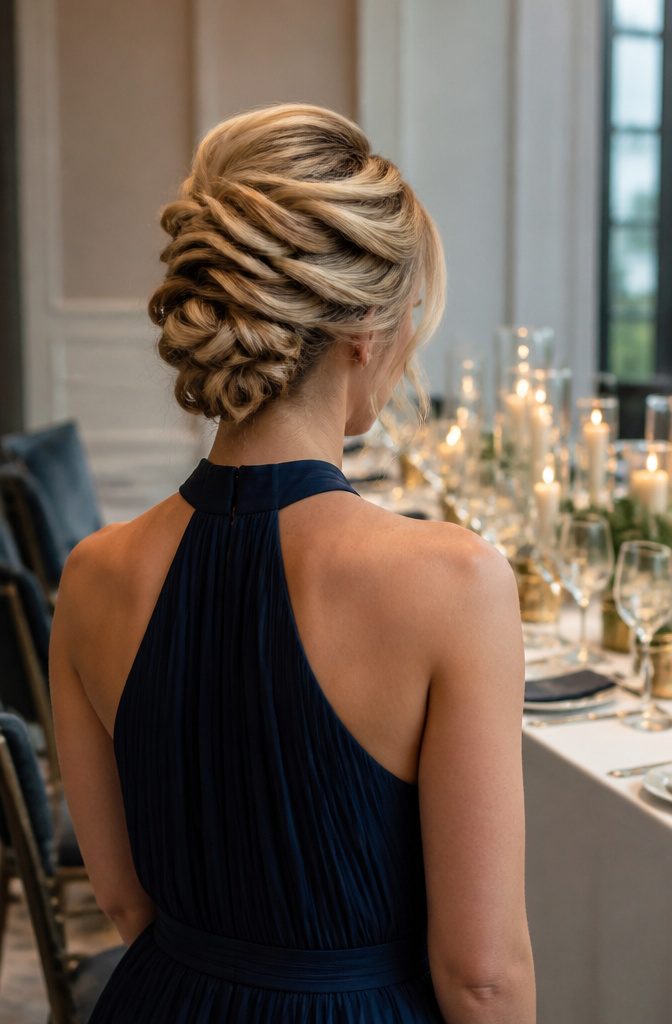
Twists pull hair back in loops rather than the three-strand rhythm of a braid, and that difference reads as cleaner geometry against a bridesmaid dress.
The technique sits somewhere between a rope braid and a pinned roll, each section twisted over the next and anchored before it has a chance to unwind.
Layers complicate this. Shorter pieces around the face want to slip out where the twist meets the scalp, so the pinning pattern matters more than the twist itself.
Loop and secure: twist, pin flat against the head, twist the next section over the pin to bury it.
Done right, the tension holds through a ceremony and the dancing after. Done wrong, the shortest layers work loose by the first toast.
Highlights shift the whole effect. A twist catches light across its raised edges the way a flat braid cannot, so balayage or streaked color turns dimensional in this style rather than reading as one flat tone.
The look reads red-carpet formal, which suits evening receptions or black-tie bridal parties where a simple bun would disappear.
9. Curly Loose Low Bun
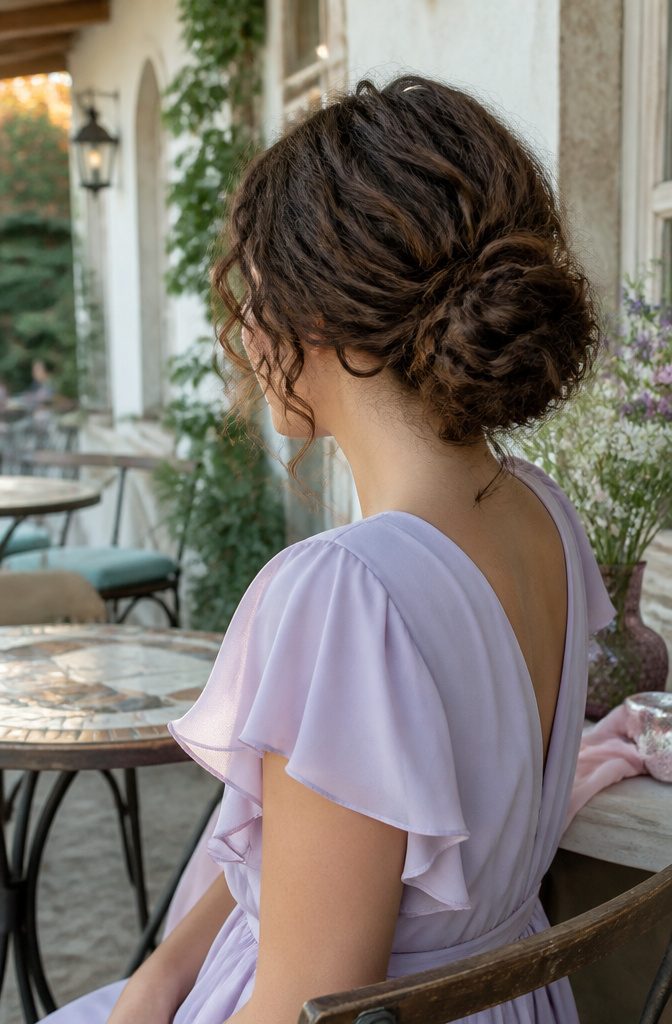
Natural curl pattern is the entire point of this style, not a problem to be solved with a flat iron.
The prep matters more than the finishing spray: a lightweight curl cream raked through soaking wet hair, then diffused on low heat until the cast forms, gives the base structure that keeps the bun from collapsing by cocktail hour.
Without that cast, the style relies on tension to hold, and tension is what turns a bridesmaid into someone counting minutes until she can take it down.
Diffusing upside down builds the volume at the root that makes a low bun sit proud rather than pancake against the neck.
The bun itself is gathered at the nape, twisted just enough to hold, and pinned with the curls still distinct enough to read as texture. Two to three bobby pins, not a dozen, keeps the headache away.
Looser curl patterns, 2B through 3A, hold this shape with the least fight. Tighter coils need more moisture retention in the prep or the outer layer frizzes where the pins go in.
The real limit is fine hair of any curl type; the density has to be there or the bun ends up wispy, and wispy reads as unfinished against a structured bridesmaid dress.
10. Waterfall Braid Hairstyle
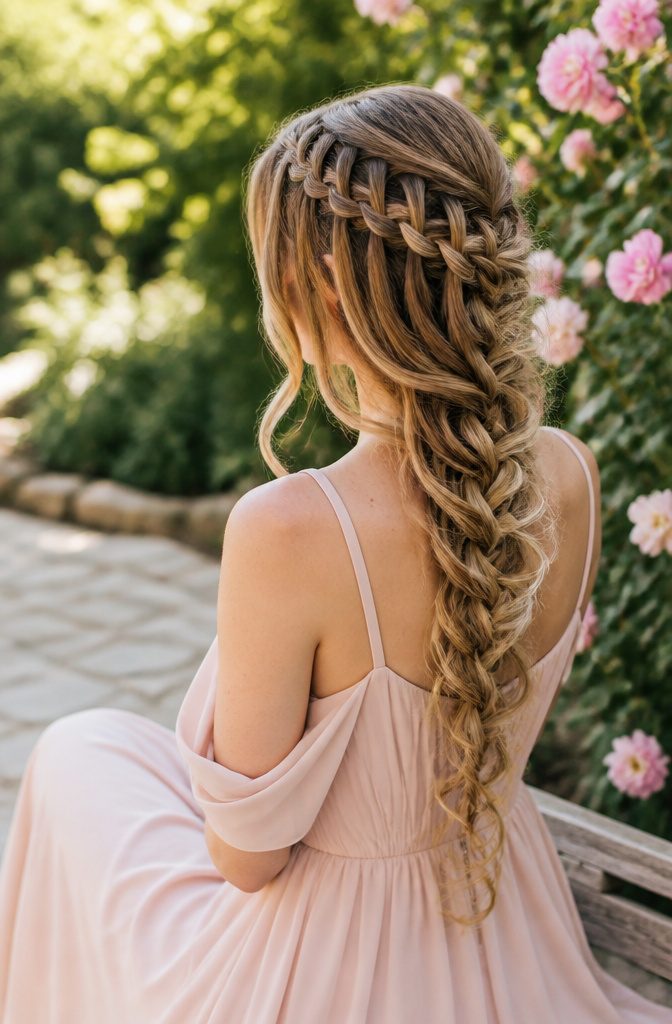
A waterfall braid gives you the structure of an updo without surrendering all your hair to it.
The braid runs along one side of the head, dropping strands as it goes so they fall loose like a cascade, while the remaining length either hangs free or gets gathered into a low bun.
It reads as more decorative than structural, which means it won’t hold up a heavy veil on its own but it will photograph beautifully in outdoor light.
Two ways to wear this: let the braid dissolve into barrel curls and loose hair past the shoulder, or feed it into a gathered base at the nape.
The first option needs hair at least medium length to show the full drop; the second works on anything past the shoulders and gains texture from highlights catching the light.
Time investment sits in the middle range. The braiding itself is repetitive once the pattern starts, but the drop strands need to be pulled free with care or the whole thing tightens into a standard french braid by accident.
Pastel dresses pair cleanly with either version, and small flowers tucked at the braid’s start soften the line where it begins.
Your bridesmaids can manage this on each other. The technique is easier to execute from the side than on yourself, and the final look benefits from a second pair of hands checking that the cascade falls evenly.
Hair Length and What Each Style Asks For
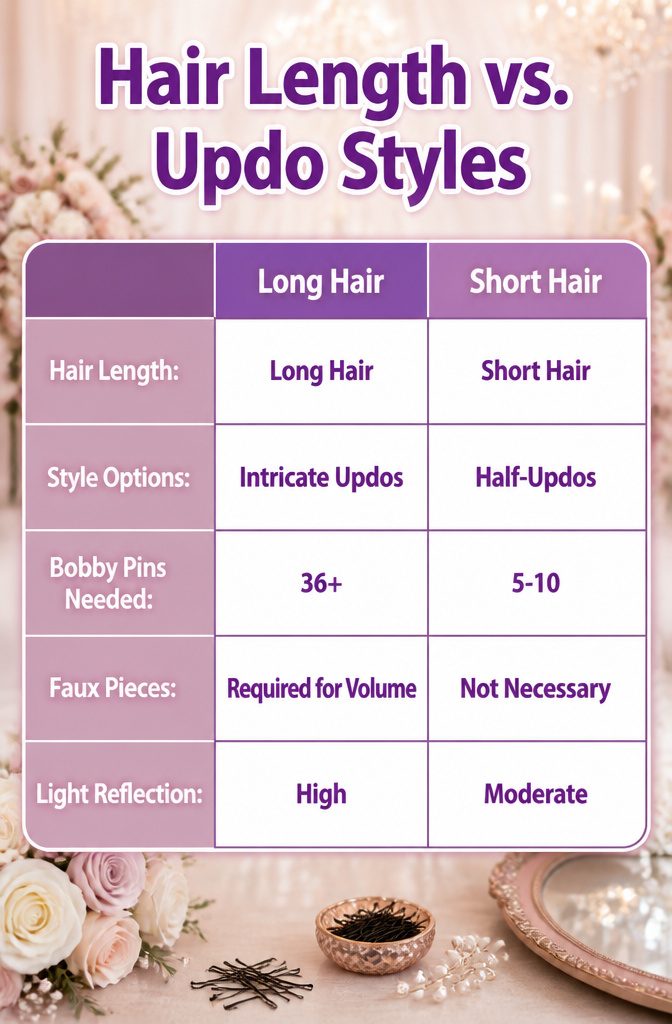
Long hair gives you room for the intricate braids and sculpted buns that read as formal from every angle, but shorter lengths shift the whole approach toward half-updos and loose curls that still lift the face without asking for bulk that isn’t there.
Bobby pins are the hidden budget line in this game: an elaborate braided bun on one bridesmaid can eat through three dozen pins, while her shoulder-length counterpart in a tousled half-updo needs barely a handful to hold the same event-long shift.
Most couples never think to ask their stylist to quote pin cost separately.
When a style demands more hair than a bridesmaid naturally carries, the false-piece option floats around wedding planning threads as an open secret, a quick clip-in that builds a low chignon or side-swept volume without the year-long grow-out.
It works, but it asks for matching that is tighter than most hotel-room mirror jobs manage, so budget the trial run if you go that route.
Blonde tones catch light through updo texture especially well; you notice the difference once you see it in afternoon ceremony light.
Accessories That Complete the Look
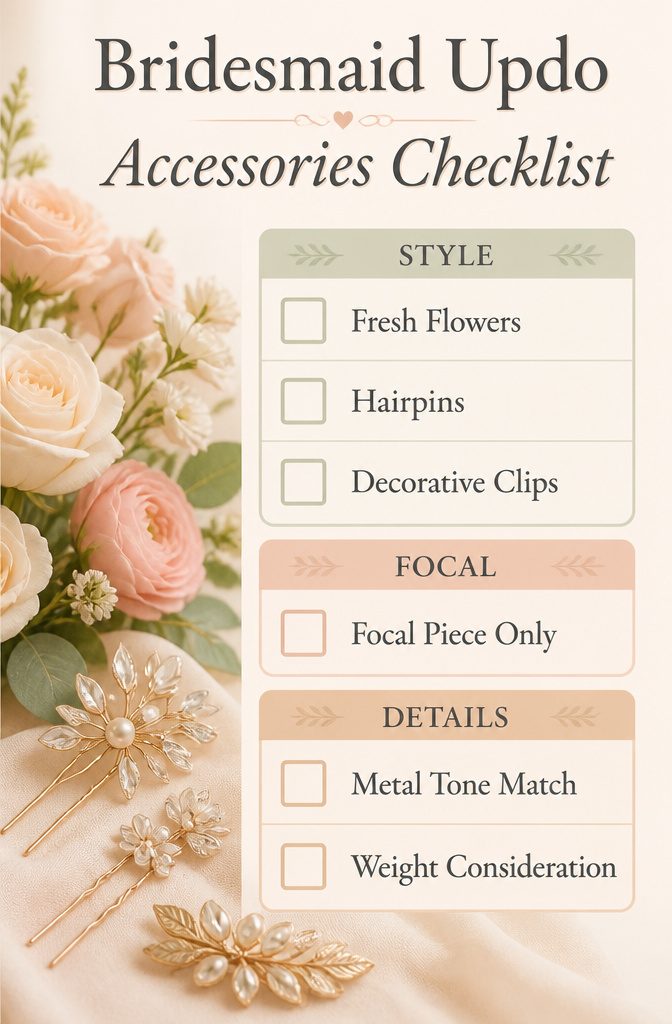
Fresh flowers, hairpins, and decorative clips each solve a different problem for a bridesmaid updo. Flowers soften a severe style; pins hold flyaways where elastics fail; clips add structure to hair that won’t hold volume on its own.
Choose only one focal piece. Two compete, and three make the back of your head look like a craft project.
Metal tone matters more than brides expect. Match the hardware to the jewelry tone the bride assigned, not the dress color.
Rose gold pins against silver bridesmaid earrings read as a mistake in photos that last decades. Most salon collections in Gainesville stock all three tones, but not every stylist remembers to ask.
Weight is where the budget accessories fail.
Oversized clips with glued-on crystals pull fine hair loose within an hour of dancing. A pin that feels heavy in your palm will feel like a lever against two bobby pins by 9 PM.
The pins I have seen in Gainesville salons run $12–$40 per piece depending on whether the stones are glass or crystal. A single well-made pin at $25 outperforms a set of six lightweight ones that scatter across the dance floor before cake.
Styling Tools and Techniques I Actually Use
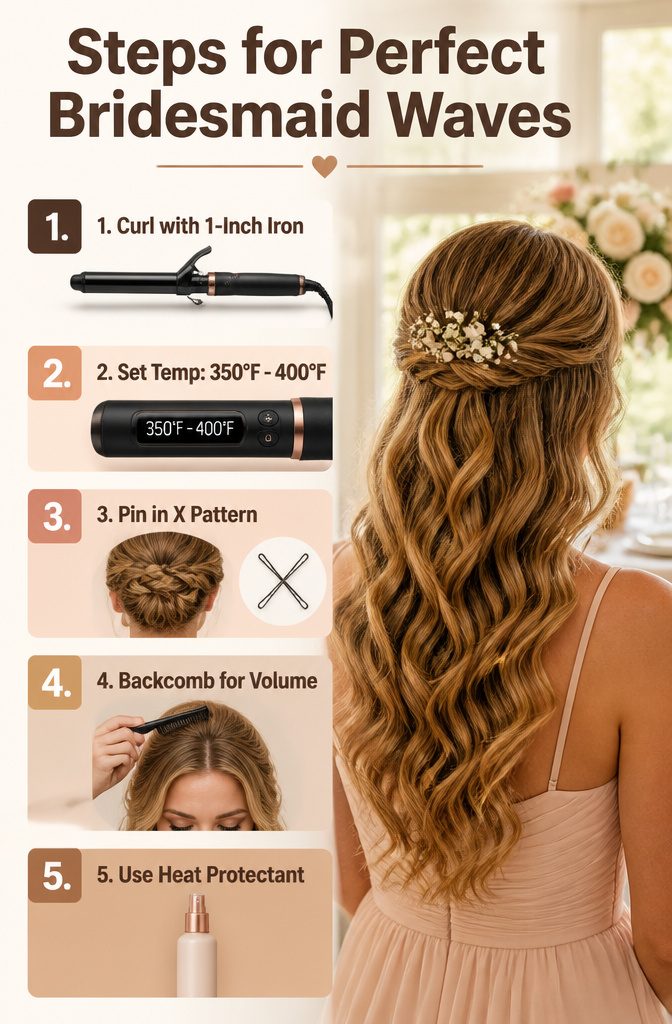
A curling iron with a one-inch barrel is the most versatile tool for bridesmaid waves that need to hold from ceremony to last dance.
I set the temperature around 350°F for fine hair and closer to 400°F for coarse textures, then wrap sections away from the face so the curl opens outward rather than closing in.
Bobby pins placed in an X pattern, not parallel lines, keep an updo secure through hours of hugging and dancing; the cross creates tension that one pin alone cannot.
Backcombing at the crown adds volume without visible teasing if you smooth the top layer with a soft brush after.
Dry shampoo sprayed at the roots before styling gives fine hair the grip it needs to stay lifted, especially in Florida humidity where I plan most weddings.
Heat protectant matters on humid afternoons; without it, curls fall flat within two hours and you spend cocktail hour reworking styles in a parking lot.
Now I keep a travel-size protectant in my kit even when the bride says her girls have already prepped.
Frequently Asked Questions
What are the best updo hairstyles for bridesmaids?
The most reliable choices are the classic bun, messy bun, and braided bun.
A low polished bun stays secure through twelve-hour wedding days, while a messy bun with intentional texture pairs well with boho or rustic themes. A braided bun adds grip for fine or slippery hair and photographs cleanly from every angle.
How do I choose a hairstyle that matches my dress?
Pair the looseness of your updo with the dress neckline. A plunging V or sweetheart cut needs only a whisper of face-framing hair, while higher necklines like bateau or illusion styles can handle more volume in those sections.
Keep face-framing strands no longer than collarbone level so they read as intentional rather than half-undone.
What accessories should I use for bridesmaid hairstyles?
Choose one focal piece from fresh flowers, hairpins, or decorative clips; two compete and three look like a craft project.
Match metal tone to the jewelry the bride assigned, not the dress color. A single well-made pin at $25 outperforms lightweight sets that scatter across the dance floor before cake.